
Introduction
This essay is based on a public lecture given at the Beaconhouse National University, Lahore in November 2025 titled The Void at the End, conceived as a performative exploration of cosmology through narrative, image, and Urdu poetry. Using a narrative structure, the lecture explored the scientific timeline of the universe, tracing its life from the earliest moment of emergence to its eventual heat death. Each cosmological stage was accompanied by a poetic intervention as a parallel mode of knowledge. While the lecture unfolded primarily as a performative and audiovisual experience, the present essay develops its underlying conceptual framework more explicitly, extending the cosmological timeline into a sustained reflection on poetry, temporality, and interdisciplinary ways of knowing.
The concept of intersectionality has traditionally been used within feminist and critical race scholarship to describe how overlapping structures of identity and power shape social experience (Crenshaw, 1989). In this essay, the concept is extended beyond identity-based analysis toward intersections of epistemology. Instead of focusing exclusively on social positionality, the paper explores how different systems of knowledge, i.e., cosmology, poetry, and philosophical reflection can integrate with one another. Intersectionality, therefore, becomes a method for thinking across disciplinary boundaries, allowing scientific and literary modes of understanding to co-exist without requiring adoption of a single explanatory framework.
In this manner, cosmic time intersects with human emotional time, and scientific explanation intersects with cultural memory. Further, contemporary scientific cosmology, articulated largely through English academic discourse, intersects in this essay with the metaphysical and poetic traditions of Urdu. In doing so, this essay proposes creative practice itself as a method of inquiry, one capable of uncovering multiple forms of knowledge together without hierarchy. Drawing on the idea that all knowledge is situated (Haraway, 1988), this work is based on the South Asian literary inheritance and contemporary scientific imagination. Scientific knowledge itself emerges through historically situated practices, instruments, and interpretive communities rather than detached observation (Latour, 1987). The universe becomes not only an object of study, but a shared narrative within which poetry, philosophy, and physics can speak to one another. The timeline of the universe thus functions as both a structure and method, allowing the vast and the intimate to unfold together.
The Big Bang: Emergence and Beginning
The Big Bang marks the beginning of the universe as it is currently understood as a moment in which space, time, matter, and energy emerge together (Weinberg, 1977). Contemporary cosmology does not describe this event as an explosion occurring within space, but as the expansion of space itself from an initial state of extreme density and temperature. While the occurrence of this emergence is widely accepted, its cause remains unknown (Carroll, 2010). Questions about what preceded the Big Bang remain unanswered, often revealing more about the human desire for knowledge rather than about the universe itself.
Religious, philosophical, and poetic traditions have long grappled with this paradox of existence arising from nothingness. In Islamic thought, the command Kun gestures toward creation as utterance rather than mechanism, suggesting emergence without explanation (Almirzanah, 2020). Urdu poetry often approaches this condition obliquely, presenting creation as hurried, imperfect, and unresolved. Jaun Eliya captures this sense of abrupt becoming with characteristic irony:

The verse captures the philosophical discomfort surrounding origins. Creation appears not as perfection but as contingency, echoing cosmology’s own unresolved questions about the con-ditions preceding the Big Bang. Here, existence is not celebrated as completion but accepted as compromise; something brought into being quickly and therefore marked by incompleteness. Creation appears less as a completely perfected act and more as an outcome shaped by sheer urgency.
Popular representations of the Big Bang have frequently framed cosmological origins as a moment of sudden illumination or revelation, reflecting the broader cultural impact of modern cosmology itself (Krauss, 2010). Contemporary cosmology, by contrast, remains cautious, recognising the limits of language and measurement at the threshold of time itself (Cox & Forshaw, 2012). Urdu poetry moves differently still, neither seeking ex-planation nor spectacle, but allowing paradox to remain intact. Mirza Ghalib articulates existence as a condition that does not negate absence, but rather emerges alongside it:
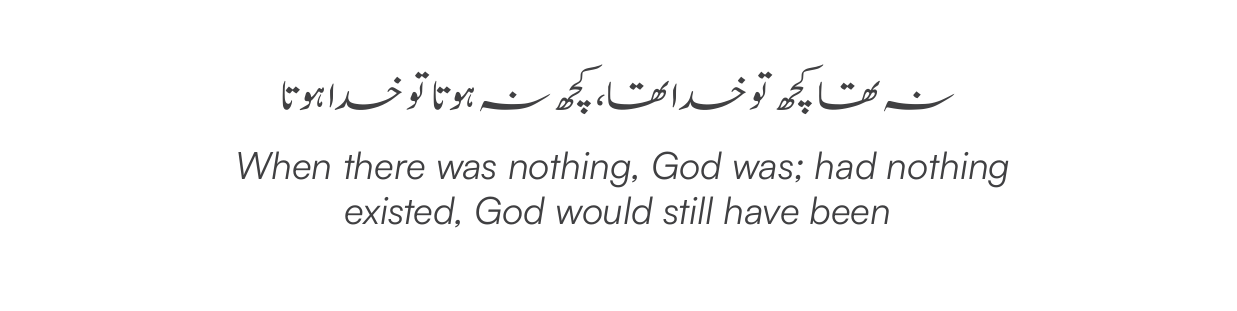
Placed against the cosmological narrative of emergence, this verse does not explain the Big Bang. Instead, it creates space for it. The beginning of the universe becomes not a solved problem but a site of wonder, where scientific uncertainty and poetic insight co-exist. Becoming takes precedence over causation, thus allowing the universe to enter the narrative as presence rather than proof.
The Early Universe: Heat, Expansion, and Becoming
Following its initial emergence, the universe entered a phase defined by extreme heat and rapid expansion (Cox & Forshaw, 2012). Energy dominated matter, and space itself stretched at a rate that defies ordinary intuition. In this early epoch, the universe was not yet a place of form or structure (Carroll, 2010). It was a field of motion and potential, gradually cooling as expansion continued, allowing the simplest elements to emerge. Hydrogen and helium formed as the first stable constituents, laying the foundations for everything that would follow (Hawking, 1988).
Although cosmological diagrams often compress this phase into a moment, the reality is different. The phase required time and thus the cooling was not abrupt. In fact, the expansion did not pause, has not paused, nor slowed down. It is still unfolding irreversibly across immense spans of time (Penrose, 2011). What appears sudden from a human vantage point is, at the cosmic scale, the result of sustained transformation. The early universe gained structure not through stability but through continuous change (Weinberg, 1977). Urdu poetic thought has long articulated this principle, recognising motion and transformation as fundamental conditions of existence rather than temporary states. Allama Iqbal captures this insight with striking clarity:
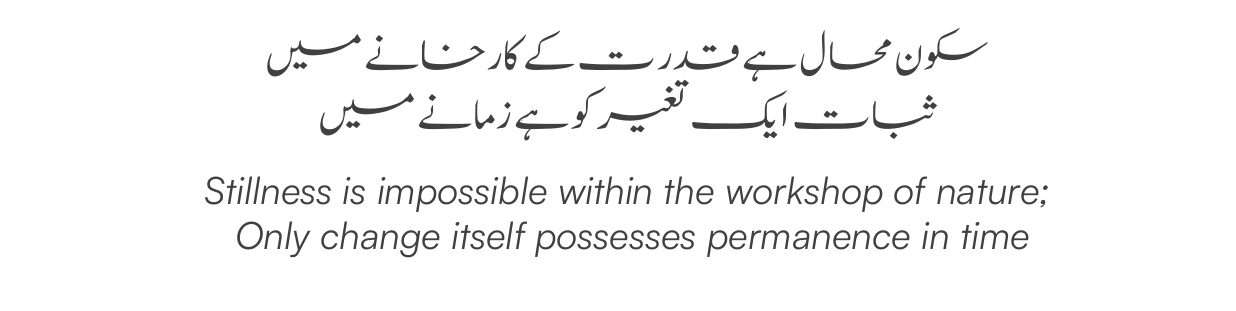
The verse reflects a philosophical understanding of becoming that closely parallels cosmological models of the early universe, where instability and motion generate the conditions necessary for structure and complexity to arise. Read alongside early cosmology, the verse resonates powerfully. Heat, expansion, and instability are not anomalies to be resolved but the very mechanisms through which form emerges. The universe does not arrive at meaning by settling into rest. It becomes what it is precisely because rest is deferred. In this sense, the early universe exemplifies a broader philosophical truth shared by both physics and poetry, i.e., existence is shaped not by equilibrium, but by the necessity of motion.
The Present Universe: Infancy at Cosmic Scale
Despite its immense age, the universe remains young when measured against its full lifespan (Carroll, 2010). At roughly fourteen billion years old, it has only begun its long movement toward equilibrium. Stars continue to form, galaxies rotate and collide, and complex chemistry persists. Heavy elements forged in stellar interiors circulate widely, consequently enabling planets, atmospheres, and life (Cox & Forshaw, 2012). From within this abundance, consciousness briefly emerges, capable of reflecting on the universe that produced it.
Yet the present is also the only temporal position we can claim with relative certainty. Our knowledge of the universe’s beginning comes through inference, models, and residual traces rather than direct witnessing. Its end remains theoretical, projected far beyond any human timescale (Cox & Forshaw, 2012). Between these two limits sits the present, the only chapter we inhabit from within, the only chapter we can measure in real time, and therefore the only chapter that can feel knowable.
Urdu poetry has long articulated this condition of limited knowledge with remarkable clarity. One does not hear the full story of existence from its opening or its closing, but from the middle, where uncertainty becomes the human condition:
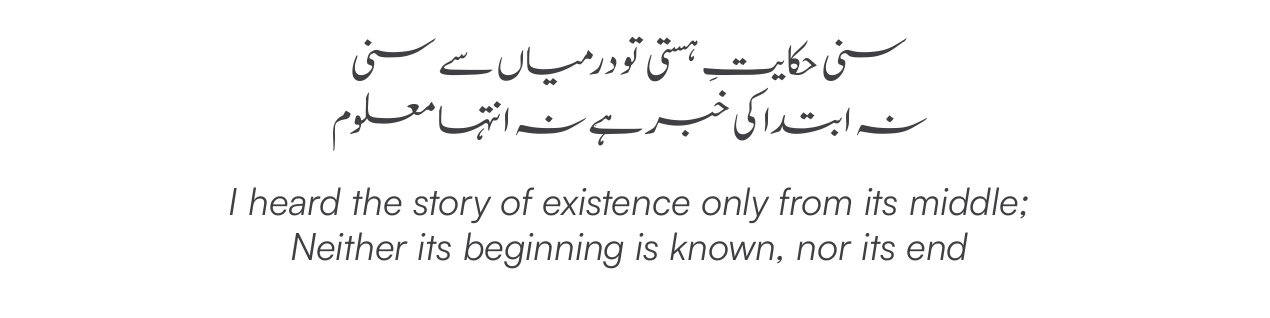
From a cosmological point of view, the couplet by Shad Azimabadi becomes an epistemic statement as much as an existential one. We listen to the tale of being from the middle because both origin and conclusion remain unseen. The present universe is vivid precisely because it is unfinished. It is a temporary clarity suspended between two relative unknowns, one behind us, one ahead of us. In recognising this, the present becomes neither a triumph nor a comfort. It becomes a location, an interval in which we make meaning while knowing that the universe began without us witnessing and will end without our presence.
Stars and Galaxies: Gravity, Motion, and Order
As the universe continued to cool, gravity emerged as the dominant organising force. Vast clouds of gas collapsed under their own weight, igniting nuclear fusion and giving birth to the first stars. These stars did not exist in isolation. Bound by gravitational attraction, they gathered into galaxies, forming immense rotating systems that structured the universe on the largest observable scales (Carroll, 2010).
Gravity imposes neither stillness nor finality. It generates order through motion, binding matter into patterns that are stable only for as long as energy permits. Stars orbit galactic centres, galaxies merge and re-organise, and cosmic structure emerges not as a completed design but as a continuously negotiated arrangement (Cox & Forshaw, 2012). Order, in this sense, is provisional. It exists within motion, not in opposition to it. Urdu poetic thought has long articulated this idea of an unfinished cosmos, one that continues to unfold rather than reach completion. Allama Iqbal gives voice to this intuition when he writes:

Considering cosmology, the couplet resonates with striking clarity. Star formation is not a closed chapter in the universe’s history, but an ongoing process. New stars continue to ignite even as others exhaust their fuel. Galaxies form, collide, and transform, responding continuously to gravitational forces that neither rest nor conclude. In a few billion years, our own galaxy, i.e., the Milky Way, is expected to collide and merge with the Andromeda galaxy (Cox & Forshaw, 2012). The universe appears ordered not because it has reached completion, but because it remains in the act of becoming.
In this current phase, creation is not confined to an origin moment. It persists through structure, motion, and repetition (Cox & Forshaw, 2012). Gravity does not bring the universe to rest; it sustains its unfinished character. The cosmos remains open, responsive, and dynamic, held together by forces that organise without resolving, and that allow form to arise without bringing change to an end.
Cosmic Expansion: Distance, Separation, and Drift
While gravity binds stars into galaxies, cosmic expansion governs the universe at its largest scale. Space itself continues to stretch, steadily increasing the distance between galaxies over time. This expansion is not a force that can be resisted or reversed. It is a property of space itself (Hawking, 1988). As a result, regions of the universe that are visible today will eventually pass beyond any possibility of contact. Light emitted from distant galaxies will weaken, redshift, and finally fail to arrive and those galaxies, stars, and worlds will be out of our reach forever (Penrose, 2011). Separation thus becomes a structural condition rather than a dramatic event.
This gradual distancing alters the meaning of connection. Galaxies may remain internally coherent, their stars bound by gravity, yet they are carried away from one another by expansion that no attraction can overcome (Carroll, 2010). The universe does not tear itself apart. It thins. What once shared a common history slowly loses the possibility of mutual awareness. This expansion transforms what was once togetherness into isolation without requiring departure. Urdu poetry has long recognised this form of separation, one that can exist even in apparent closeness as described by Adeem Hashmi:
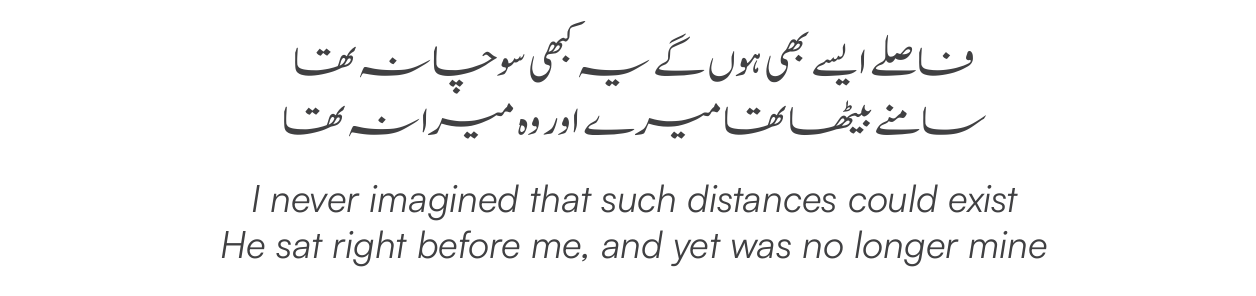
The couplet offers an evocative metaphor for cosmic expansion, where increasing distance transforms relation itself rather than simply enlarging space. From a cosmological perspective, the couplet captures the logic of an expanding universe with remarkable precision. Distance here is not only a matter of space, but of relation. Even what appears near becomes unreachable. Expansion does not merely increase physical separation. It alters the terms under which connection is possible at all. In this phase of the universe, distance becomes embedded in structure rather than movement. Separation unfolds quietly, realized by the fabric of space itself. What remains is not catastrophe, but solitude. The cosmos continues to exist, but increasingly alone, its shared horizons slowly dissolving into unreachable elsewhere.
Stellar Death and the Dimming of Light
As cosmic expansion carries galaxies apart, another process unfolds within them. Stars, the primary sources of light and structure, are not permanent. Each star is sustained by a finite reserve of fuel. Nuclear fusion allows it to shine, but only by steadily consuming the material that keeps it alive. Over time, this balance fails. Massive stars exhaust their fuel quickly and die violently, collapsing or exploding and dispersing heavy elements into space. Smaller stars burn more slowly, fading over immense spans of time into dim remnants (Cox & Forshaw, 2012)
This phase marks a decisive shift in the character of the universe. Where earlier epochs were defined by abundance and formation, stellar death introduces gradual scarcity. Star formation continues for a while, but at a diminishing pace (Cox & Forshaw, 2012). The universe does not suddenly lose its light. It spends it slowly. Illumination persists precisely because exhaustion is slow. Urdu poetry has long understood this logic of endurance followed by depletion. Ahmed Faraz captures the paradox of delayed extinction with quiet precision:
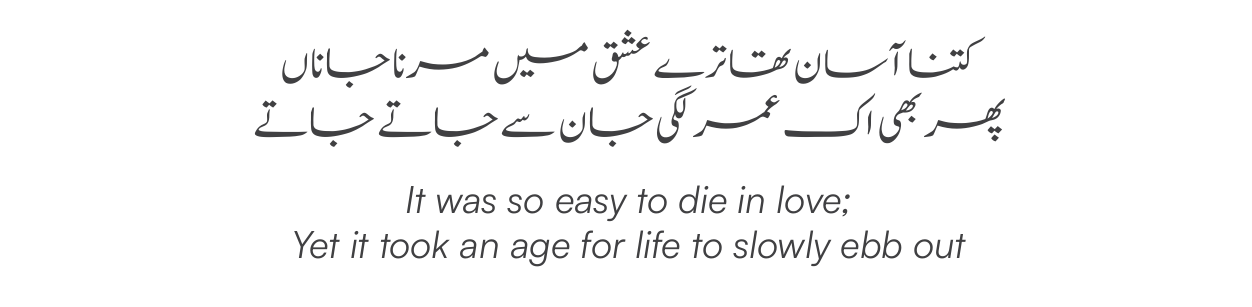
Read alongside stellar evolution, the verse speaks directly about the fate of stars. Burning itself is not difficult for the star. What takes time is finishing the burn. Stars do not die at the moment they ignite, but only after enduring the long task of shining. Their death is postponed by the very success of their radiance. In this era of the universe, extinction is not abrupt. It is stretched across time. The sky grows darker not through collapse, but through patience. Light fades because it has already done its work. What remains are traces, remnants, and a universe slowly learning how to exist without illumination.
Entropy, the Void, and the End of Structure
After the last stars fade, the universe enters a phase governed not by formation or illumination, but by entropy. Energy gradients flatten and all motion slows down. Structures that once sustained complexity gradually dissolve. What remains are cold remnants, inert matter, and vast stretches of space where nothing meaningful occurs (Cox & Forshaw, 2012). The universe does not collapse into ruin. It thins into uniformity.
In this late epoch, familiar markers of time lose their significance. Without stars to burn or processes to distinguish one moment from the next, change becomes negligible. Black holes persist longer than any other structures, yet even they are not permanent. Over inconceivably long spans, they evaporate, releasing their remaining energy into an already cold universe (Hawking, 1988). Whether protons themselves decay remains uncertain, but either outcome leads toward the same condition: a universe incapable of sustaining structure, chemistry, or memory (Carroll, 2010). Faiz Ahmed Faiz articulated the experience of arrival that fails to fulfill expectation, of an ending that does not deliver the promised resolution. With stark clarity, he has said:
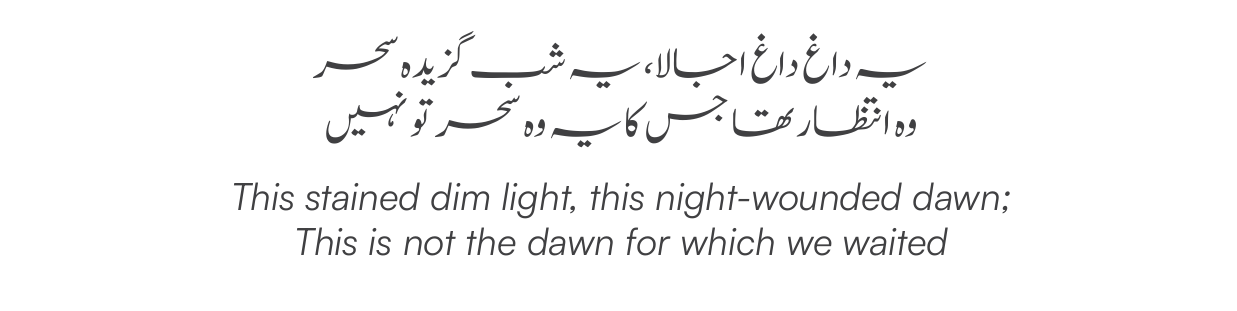
In this context, the verse becomes an interpretive lens for entropy, framing the universe’s final state not as a dramatic collapse but as a quiet exhaustion of expectation. Viewed from a cosmological frame, the couplet presents the idea of heat death as an anticlimax rather than a catastrophe. The end of the universe does not arrive as a revelation or closure. It arrives as a muted remainder, a darkened dawn that bears the marks of exhaustion rather than renewal. What was awaited as an end turns out not to be the end that was imagined. In this final phase, the universe does not announce its conclusion. It persists in a diminished state, stripped of contrast and event. Time continues, but without narrative. Space remains, but without landmarks (Penrose, 2011). Entropy completes its work not by destruction, but by erasure of difference. What is left is not nothingness, but a void so uniform that finally nothing further can happen within it and we are left in the void.
Intersectionality as Creative Method and Conclusion
This essay has traced a cosmological timeline not to narrate the universe as a spectacle, but to use the universe’s journey as a method of thinking. By juxtaposing contemporary cosmology with Urdu poetry, it has treated intersectionality not as a taxonomy of identities, but as a practice of relation. Science and poetry are not reconciled here, nor reduced to metaphor for one another. They emerge instead as parallel modes of inquiry, each grappling with time, finitude, and becoming through different but equally partial forms of access.
Intersectionality, understood in this way, becomes a discipline of attentiveness. Cosmology relies on inference, mathematics, and instruments that translate the unobservable into structure. Poetry works through language, silence, and ambiguity, allowing meaning to emerge without resolution. Both acknowledge limits. Both operate at thresholds where (un)certainty gives way to speculation. Their intersection does not resolve these uncertainties, but makes them inhabitable.
Even at the far edges of cosmological thought, finality remains provisional. While entropy describes a universe trending toward uniformity and stillness, physics does not foreclose all possibility. Theoretical constructs such as the Boltzmann brain suggest that, given sufficient time, consciousness could briefly re-emerge through random fluctuation (Carroll, 2010). Other models allow for quantum instability or the spontaneous emergence of new universes from vacuum states, events that would resemble new beginnings without requiring intention or design (Penrose, 2011). These ideas are not predictions, but reminders that closure in cosmology is always conditional.
It is here that an Urdu verse by Naresh Kumar Shad offers a quiet counterbalance, not by denying darkness, but by refusing to treat it as absolute. Hope appears not as certainty, but as possibility held open against despair:
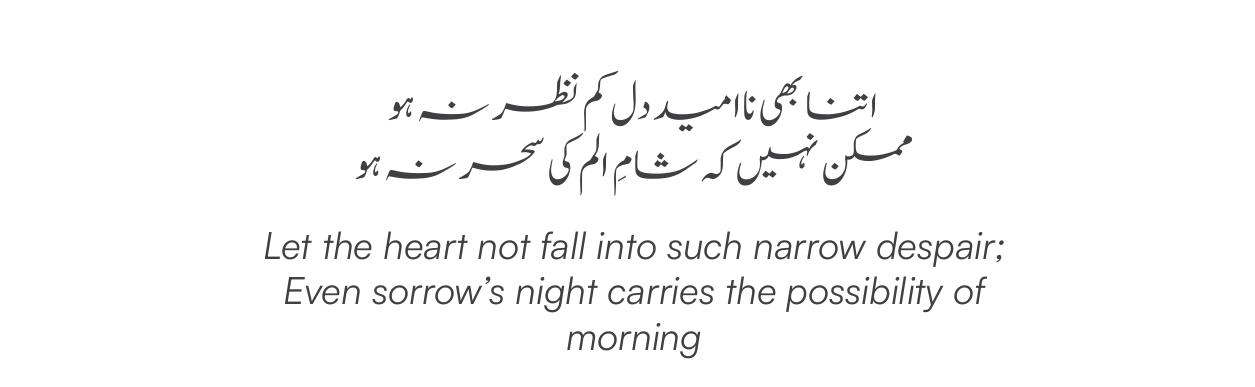
Read alongside cosmology, the couplet does not promise renewal. It resists total negation. It suggests that even where endings seem complete, imagination need not concede finality. Absence may still contain the conditions for emergence, however improbable.
To think intersectionally, then, is to remain with these unfinished spaces. It is to resist the demand for definitive endings, whether scientific or poetic, and to treat knowledge as situated, relational, and open to revision. In a universe that begins without our witnessing and may end beyond our presence, creative inquiry becomes an act of care within the interval we inhabit. Meaning does not depend on permanence. It arises through attention, relation, and the willingness to think at the edges of what can be known, where silence does not cancel meaning and where new beginnings, however unlikely, are never entirely ruled out.