
Abstract:
This paper examines a series of three site-specific installations at Villa M organized by Loop Art Residency on the fire-devastated island of Evia, Greece. Reimagining the Greek mythic figures of Atlas, Sisyphus, and Prometheus through local charred materials and animal remains, the project explores the intersection of ecological catastrophe, political tension, and ontological crisis. Grounded in a posthuman framework, the work dismantles hierarchies between human and non-human suffering, offering a material architecture of endurance in a damaged world.
Introduction
On Evia Island, a climate-driven catastrophe has left the land blackened. Dead animals and plants lie in burnt forests; the ground still carries pieces of bodies, dusted bones. Skulls, bones, and charred fragments are gathered as material evidence of destruction in site-specific works titled “The Trilogy of Eternal Condemnation”—my three installations at Villa M, Loop Art Residency on Evia Island in Greece. They form part of how the island remembers its very identity holding the weight of both human and more-than-human precarity. Into this material archive enter Atlas, Prometheus, and Sisyphus—figures of Greek mythology whose eternal punishments resonate with contemporary struggle. Their cycles of disobedience, resistance, repetition, and collapse echo the conditions of the island today. Reimagined through local materials, sourced in this damaged landscape, the works link the ontology of Greek myth to the material identity of Evia today, holding together different temporalities without a timeline. The ground of Evia no longer functions as mere landscape; it has been converted into a terminal archive. If we follow Michel Foucault’s (1972) definition, an archive is not a silent repository of the past, but the “system of dispersibility” that dictates what is allowed to emerge as reality. On this island, the “dusted bones” and charred fibers are not just remains—they are statements.
They consider how elemental forces—fire and sky—shift in meaning under today’s planetary conditions, refracted through environmental catastrophe that destabilizes the very cosmologies these elements once upheld. The project questions the anthropocentric worldview through a posthuman lens, where matter and memory converge, and where hierarchies between human and non-human life are dismantled. Here, ecological devastation, human labor, and animal remains intertwine with mythic endurance, exposing a shared vulnerability across species and time. Through Prometheus, the site-specific project asks: if fire was a stolen knowledge—an elemental power humans were never meant to possess—what has this gift produced today?
This research operates at the intersection of three crises: the ecological (the blackened landscapes of Evia), the geopolitical (the escalating wars and political tensions in West Asia), and the ontological (the ancient Greek myths that dictate the boundaries of suffering in its repetitive and eternal forms). The Trilogy moves beyond the single-axis of ‘environmental art’ to practices of intersectionality, functioning as laboratories where materials, bodies, and mythologies negotiate timeless condemnation in a posthuman archive of a damaged world, where everything is interconnected in its suffering, requiring what Donna Haraway (2016) describes as ‘staying with the trouble’ of a damaged planet.
Atlas
In the burnt peripheries of Greece, mythology ceased to be a story and became a physical weight. As an artist archiving the memory of materials and places, I arrived in October 2024 on Evia carrying a “burden” on my shoulders, weighted by the constant arrival of war news and images of the dead and ruins, with escalating political tension from West Asia. There was the horizon of the calm, beautiful Aegean Sea touching the skies of sunrise, and then, in the opposite direction, we encountered a landscape that was blackened and charred—a cadaver of a forest condemned to death by dryness, fire, and human neglect. Here, the ecological collapse was visible in every piece of ash. I began to ask: do this land and its creatures remember the eternal punishment of Atlas? Are the birds, the trees, and the non-human beings condemned to suffer alongside him, carrying a weight they did not choose?
This is the core of eternal condemnation: the inability to rest, to have a pause, or to ever put down the burden. As Albert Camus suggests in his reflection on the absurd (1955), “The struggle itself toward the heights is enough to fill a man’s heart.” But on Evia, the struggle is not toward the heights; it is a horizontal endurance through the ruins. Atlas is no longer a distant deity; he is the material identity of a landscape that cannot breathe, a primordial space condemned whose spine is fused with the charred remains of the earth.
To physically manifest this weight, I integrated my archiving matter practice with a found structural remnant—a pre-existing wooden sphere left in the garden of Villa M—transforming it through a site-specific intervention into the ‘Atlas dome’. By ritually covering this found structure with palm leaves that I gathered and cut daily from the dead trees, I reconfigured it into a celestial ceiling designed to rain over the remains of the land. Departing from traditional artistic historical representations that depict Atlas as a human figure bearing a solid sphere on his shoulders, this intervention isolates the sphere itself, removing the human protagonist to let the structural burden speak entirely through the landscape’s matter. I integrated this dome with the dead bones and skulls of animals found in the black land and forest, while a water system hidden behind the palm leaves was built to mimic a perpetual rain. In the process of creating, repetitive action became crucial. Like a ritualistic farmer salvaging remnants, I was gathering bones instead of seeds—skulls, spines, and pelvic bones. Many of them were blackened by the fire. I washed them, dried them, and touched them—a posthuman archive.
The silence of the burnt forest, the landscape of the sea were constantly interrupted by the distant, invisible noise of a world in crisis. I was standing in Greece, but my mind was anchored in the escalating shadows of West Asia; war in Palestine, suffocating tension, and the constant threat of war looming over Iran, where my family and friends remained, while simultaneously witnessing the shared grief of the residency organizer, whose home in Lebanon had become an active battlefield.
Every night, I began to dig a hole, learning how to use different shovels for this heavy labor. Seeking to create a small pond—a designated reservoir for water that the scorched earth desperately needed—I was ritually gathering water for the bones. To feed this pond and simulate a perpetual rain falling from above, I designed a closed water system. I routed a hidden network of perforated tubes behind the palm leaves of the dome structure, connected to a submersible pump that continuously pushed water through the holes in the pipe. They needed rain. I planned this water system to create an uninterrupted cycle of falling water over the remains. The process of making the central hole took many days and hours; it became as absurd as Atlas carrying his burden. Why was I digging? What was art in this act? I was searching for an answer in the soil—the same soil that, throughout history, grew the seeds of many myths.
I was questioning the soil, searching within it. The dome structure was finished with a wooden web covered by tubes and palm leaves. I began to “hang the dead,” letting them have their macabre dance. I used restoration gauze and cotton rope around the spines and skulls and bones, playing the role of a doctor for the already dead. Every night, the bones would fall. Every night, I was condemned to make them dance in the wind again. I was hanging them, and hanging them again. Every night, the spine would slip; every night, the rope would untie. I was gathering, I was washing, I was digging—again and again. This was the absurdity of the repetition: to fix what is already broken, to uphold what is already fallen.
As Arthur Schopenhauer (1818/1966) observed, the human “will” is an endless, restless striving—a blind urge that exists without a final goal. My digging was this blind urge. In the rhythm of the shovel hitting the dry earth, I found the ‘science of freedom’ Joseph Beuys (as cited in Tisdall, 1979) spoke of—where the act of shaping the earth becomes a pedagogical tool for liberation. I did not know when to stop. The deeper I went, the more I questioned the nature of this burden: Is Atlas holding the consequences of our failure to be kin to the earth? I began to see that his burden is not a physical weight, but the ontological weight of a “posthuman” world where the sky is no longer a divine ceiling, but an atmosphere destabilized by our own hands.
By digging, I was not searching for a grave, but for the roots of this planetary exhaustion. In extracting the soil, I felt as if something sacred had been stolen— perhaps an answer—and for that theft, we were condemned forever.
The pond was ready. I filled it with water and activated the system; soon, the bones were in the wind and in the rain. I placed white stones on the ground—a Zen garden of death? In Zen, the garden is a space to witness Mujo (impermanence); it is where the stone represents the eternal and the water represents the fleeting (Hisamatsu, 1971). The pond was beautiful until I found a turtle shell; just a shell, black and destroyed—a home without a being. In this shell, I found the essence of Wabi-sabi: the profound beauty found in the broken, the scorched, and the abandoned (Suzuki, 1959). By placing it into the center of this ritualistic pond, I created a space where the living and the dead meet. Zen is often found in the ‘Mu’ (無)—the void or the presence of what is missing. Here, the contradiction of a ‘home without a being’ became a meditation on the absence that defines our era. Beside this dead garden, I “planted” a tree—a spine-tree. I raised a huge, vertical spine and connected it to a very thin tank using gauze. It stood as a dystopian stick in the earth, a monument to the power of being powerless.
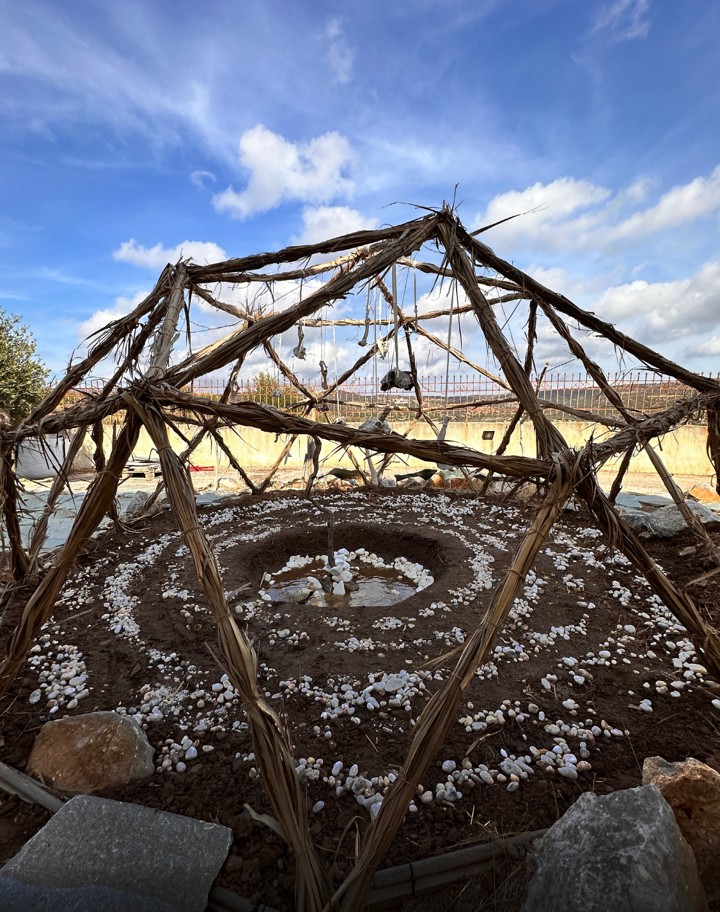
Figure 1. Atlas Dome (The Trilogy of Eternal Condemnation), 2024, site-specific installation with wood, palm leaves, animal skulls and bones, rope, restoration gauze, fabric, stones, and water system tube (materials gathered from the island’s burnt landscapes, marked by forest fires and animal deaths caused by climate change), dome diameter 400 cm (157.5 in), Evia, GR
No Direction Home, LOOP, Evia, GR
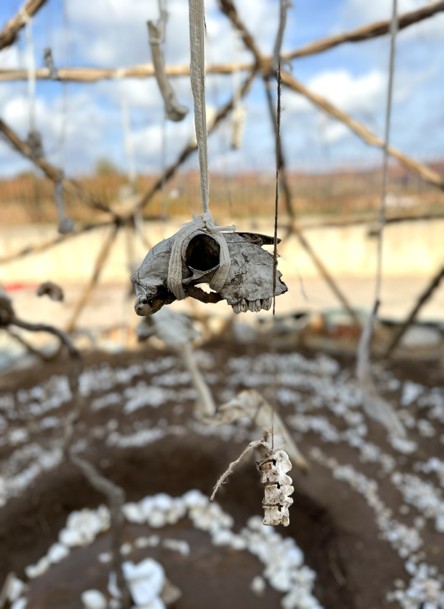
Figure 1.1. Atlas Dome (Detail)
Figure 1.2. Atlas Dome (Detail)
Sisyphus
If Atlas is the weight, Sisyphus is the distance. On the coast of Evia, the myth shifted from a mountain to a shoreline. I found a massive stone south of Villa M, a natural monument standing against the horizon of the sea. After the vertical burden of At-las, this stone was a sign of a new condemnation: a horizontal struggle across the parched earth.
The installation Sisyphus is a 20-meter scar across the landscape. I used coal and ash from the burnt forest to mark two lines on the earth—a charcoal rail connecting the ancient to the industrial. At one end sits a gigantic, abandoned children’s toy car, a plastic ghost found in the sand near a construction site. This is not a gift from the tide; it is a relic of industrial play.
Why is this object here? It was found in the shadow of the yellow crane that drilled from sunrise until sunset—extracting, changing the lands, and changing the stone. The stones loaded into the back of this “toy” are not smooth sea-pebbles; they are jagged, industrial debris extracted by the crane from the exact construction site where the crane itself became a mechanical Sisyphus. Is the one sitting in that crane, carrying stones from one part of the land to another, any less condemned than Sisyphus carrying his stone up the hill? What is happening to the being and non- being of this island? How they are displaced, burnt, and shifted by the human magic wand of “progress” and greed?
As Camus (1955) suggests, the absurd is born from the confrontation between human need and the “unreasonable silence of the world.” By dragging this plastic car—a sign of the very machines that drive climate collapse—through 20 meters of charcoal, the work performs a ritual of repetitive grief, displaced oppressed stones. If in Atlas, I was questioning and in dialogue with water and soil, here my ally was stone. Yet, within this eternal condemnation, rarely does anyone consider the perspective of the material itself: how did the stone Sisyphus carried feel, if it could feel? What is the true role of the stone in this environmental devastation? Even when you are a stone—heavy and unchangeable—they change you. They change your pacing, they change your shape, playfully and absurdly, at the cost of the devastation of all. This is our sign on you, stone: a human rebel who wants to refuse, but whose marks are only black charcoal that will be washed clean by the first rain.
Alongside the charcoal line, a sound installation played the constant, violent labor of drills and cranes. This is what Martin Heidegger (1977) termed “Enframing” (Gestell): the technological gaze that reduces the Earth to a “standing reserve” for human expansion. The crane’s noise is the soundtrack to Sisyphus’s labor, the industrial “progress” that continues to scream against the twilight. I began to draw a visual lexicon of archaic glyphs and rebel figures upon the stone with charcoal. While watching Werner Herzog’s Cave of Forgotten Dreams on a screen flickering in the wind, the connection between the ancient hand and the industrial machine became clear. The repetitive act of drawing became my own resistance. We are not just dragging a car; we are manifesting a revolutionary impulse—the active force of more-than-human beings who refuse to be “enframed.” Like the Sisyphus of Camus (1955), I found that the struggle itself is enough to fill a heart, even while playing with the toys of our own destruction.
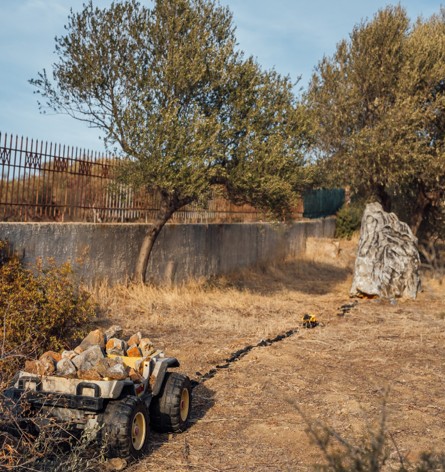
Figure 2. Sisyphus (The Trilogy of Eternal Condemnation), 2024, site-specific installation with found children’s car, stones (gathered from industrial construction site), charcoal, ashes, spanning approximately 20 × 1.5 × 0.8 m (65.6 × 4.9 × 2.6 ft), Evia, GR
No Direction Home, 2024, LOOP Athens, GR
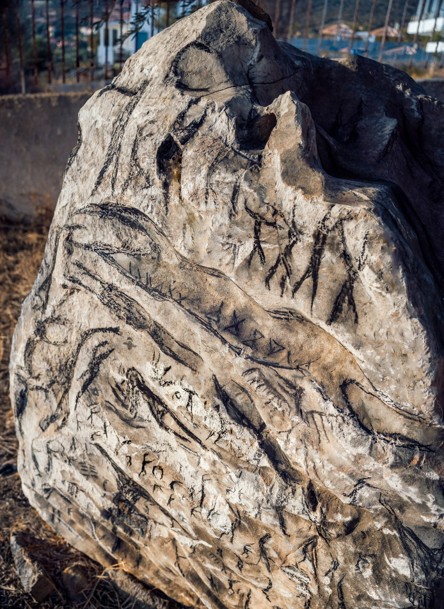
Figure 2.1. Sisyphus (Detail)
Prometheus
If Atlas is the weight and Sisyphus is the distance, Prometheus is the cost. In the final installation of the trilogy, I returned to the meat, exploring the inseparable threads of connection between flesh and fire. Through Prometheus, the work asks: if fire was a stolen knowledge—an elemental power humans were never meant to possess—what has this gift produced today?
As we consume the non-human being without question, and as we build blackened landscapes for the very animals whose meat we eat, I wanted to see things through an eagle’s eye, from above. I gathered dried wood and fallen twigs into a circular nest—a nest for a liver. In Greek mythology, Prometheus’s punishment was to have his liver eaten daily by an eagle, only for it to regenerate every night—a cycle of eternal extraction. To bring this material memory into the present, I sourced a real, raw animal liver from a local butcher shop in Evia, placing it at the center of the installation where a chain hung over a spine and the liver. By leaving this raw meat exposed to the elements, the installation became dynamic; it was left to decompose or be consumed by the local wildlife and insects—the real-world equivalents of Prometheus’s eagle. Where is the home of meat? This nest on the earth was made from the bones of dead animals and rusted fencing. They faced one another, as if in a hidden conversation between spine and meat across a rusted fence.
Prometheus stole fire—the first technology—and for this, his body became a site of eternal extraction. In the burnt forests of Evia, this “gift” of fire has matured into a catastrophe. As Heidegger (1977) warned, the danger of technology is not the machine itself, but the way it transforms the world and the human body into a “standing reserve.” Here, the liver is not just a growing organ; it is the material memory of sacrifice. Can the meat survive the fire it helped create? By placing the liver in a nest of burnt twigs, I am asking: what is left of our biological being when the “fire” of progress has consumed the horizon? This return to the meat is an encounter with our own being through flesh. The spine and the liver in the rusted cage are the last remains of a “posthuman” anatomy—a specimen of what it means to be alive in a land that has been scorched by its own knowledge. If there were bones and skulls to be found on the land, meat could only be found in a shop; there is no meat left upon the blackened earth. Meat is precious; it makes the human “more human” only to consume, to extract, and to feed a bigger fire.
Conclusion
The Trilogy of Eternal Condemnation does not seek to restore what was lost, nor does it offer the false comfort of a solution. It is a site-specific architecture of endurance. By weaving together the island’s trauma—burnt wood, restoration gauze, animal bones, and industrial debris—the work embodies what Donna Haraway (2016) identifies as the necessity of “staying with the trouble.” To exist in this era is to refuse the easy exits of optimism or despair. Whether we are digging a hole for a rain that never comes, dragging a plastic ghost across a charcoal scar, or watching a liver perish in a nest of ash, we are participating in a shared devastation. Atlas, Sisyphus, and Prometheus are no longer distant myths; they are the names of our current condition. We are not just holding the weight; we are digging through it, marking it with charcoal, and feeding it with our own flesh, finding a way to exist within the contradictions of a damaged world. Beside the dead garden, my spine-tree remains—a dystopian stick in the earth, a monument to the power of being powerless.
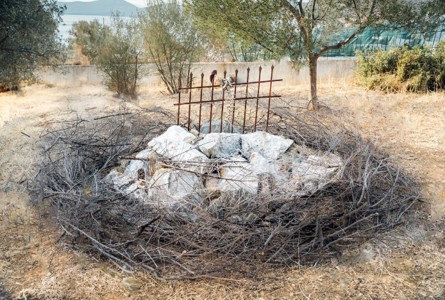
Figure 3. Prometheus (The Trilogy of Eternal Condemnation), 2024, liver meat, wood, stone, fence, branches, animal skulls and bones, iron chain (materials gathered from the island’s burnt landscapes, marked by forest fires and animal deaths caused by climate change), 150 x 400 x 400 cm, Evia, GR
No Direction Home, 2024, LOOP Athens, GR
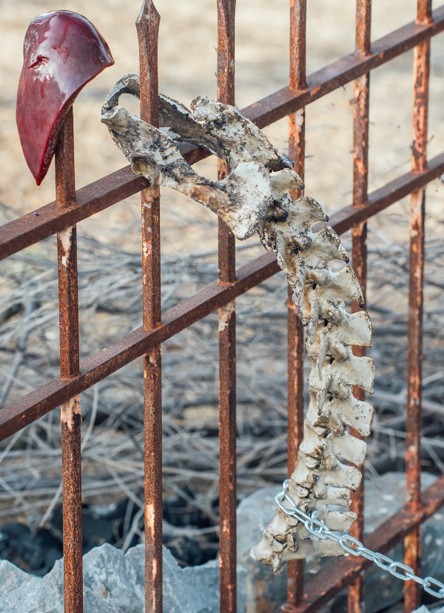
Figure 3.1. Prometheus (Detail)
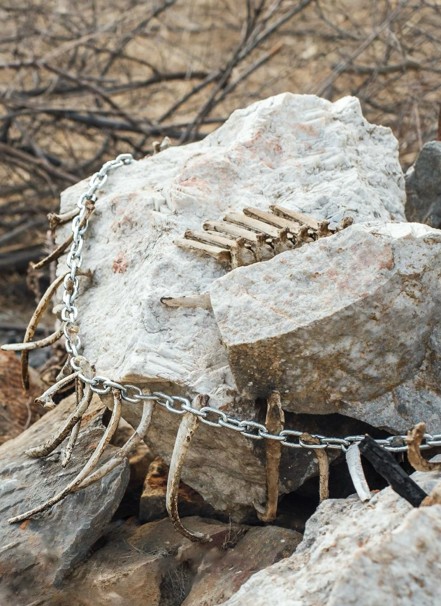
Figure 3.2. Prometheus (Detail)
References
01. Camus, (1955). The myth of Sisyphus and other essays (J. O’Brien, Trans.). Alfred A. Knopf.
02. Foucault, M. (1972). The archaeology of knowledge and the discourse on language (A. M. Sheridan Smith, Trans.). Pantheon Books.
03. Haraway, D. J. (2016). Staying with the trouble: Making kin in the Chthulucene. Duke University
04. Heidegger, M. (1977). The question concerning technology, and other essays (W. Lovitt, ). Harper & Row.
05. Hisamatsu, (1971). Zen and the Fine Arts (G. Tokiwa, Trans.). Kodansha International.
06. Schopenhauer, A. (1966). The world as will and representation (E. F. J. Payne, Trans.; Vol. 1). Dover Publications. (Original work published 1818).
07. Suzuki, T. (1959). Zen and Japanese Culture. Princeton University Press.
08. Tisdall, (1979). Joseph Beuys. Solomon R. Guggenheim Museum.