
Abstract:
Each winter, Lahore records some of the highest air-pollution levels in the world: the result of poorly refined fuels, mismanaged traffic, illegal industrial energy sources, unchecked emissions, and pervasive construction dust. While the pollution blankets the entire city, its consequences are unevenly distributed, shaped by class, income, education, and urban geography.
Working-class neighborhoods, often located near industrial corridors and major traffic arteries, bear the heaviest burden. Residents in these areas experience higher rates of respiratory illness, stillbirths, and mental health issues, despite contributing least to the problem. Accessing medical care frequently requires traveling long distances across the city, a cost many low-income families can barely afford. Health outcomes are further complicated by limited educational infrastructure, where children and their families grow up with reduced awareness, fewer protections, and without means to escape polluted environments.
Official records suggest regulatory compliance, yet lived realities tell a different story. Construction sites operate amid visible dust clouds, factory chimneys often emit untreated smoke, and vehicular exhaust remains largely under-controlled.
Although upper-income areas are not immune to hazardous air, financial resources allow partial insulation through private healthcare and access to air purification technologies. For families earning about one hundred dollars a month, a one-time cost of one hundred and fifty dollars for an air purifier is unattainable. Exposure, therefore, becomes a condition of poverty.
Recent years have seen the emergence of locally led scientific research and citizen-led legal and environmental advocacy, occasionally resulting in court victories. Still, meaningful change depends on systematic monitoring, transparent data, and political accountability.
Lahore’s air pollution illustrates how environmental harm intersects with economic inequality, urban planning, education, and public health. It raises a fundamental question for Pakistan’s future: whether clean air can be recognized not as a privilege, but as a constitutional right?
I thank Dr. Aurangzeb Haneef for his help in connecting me with some of the people consulted for this photo essay.
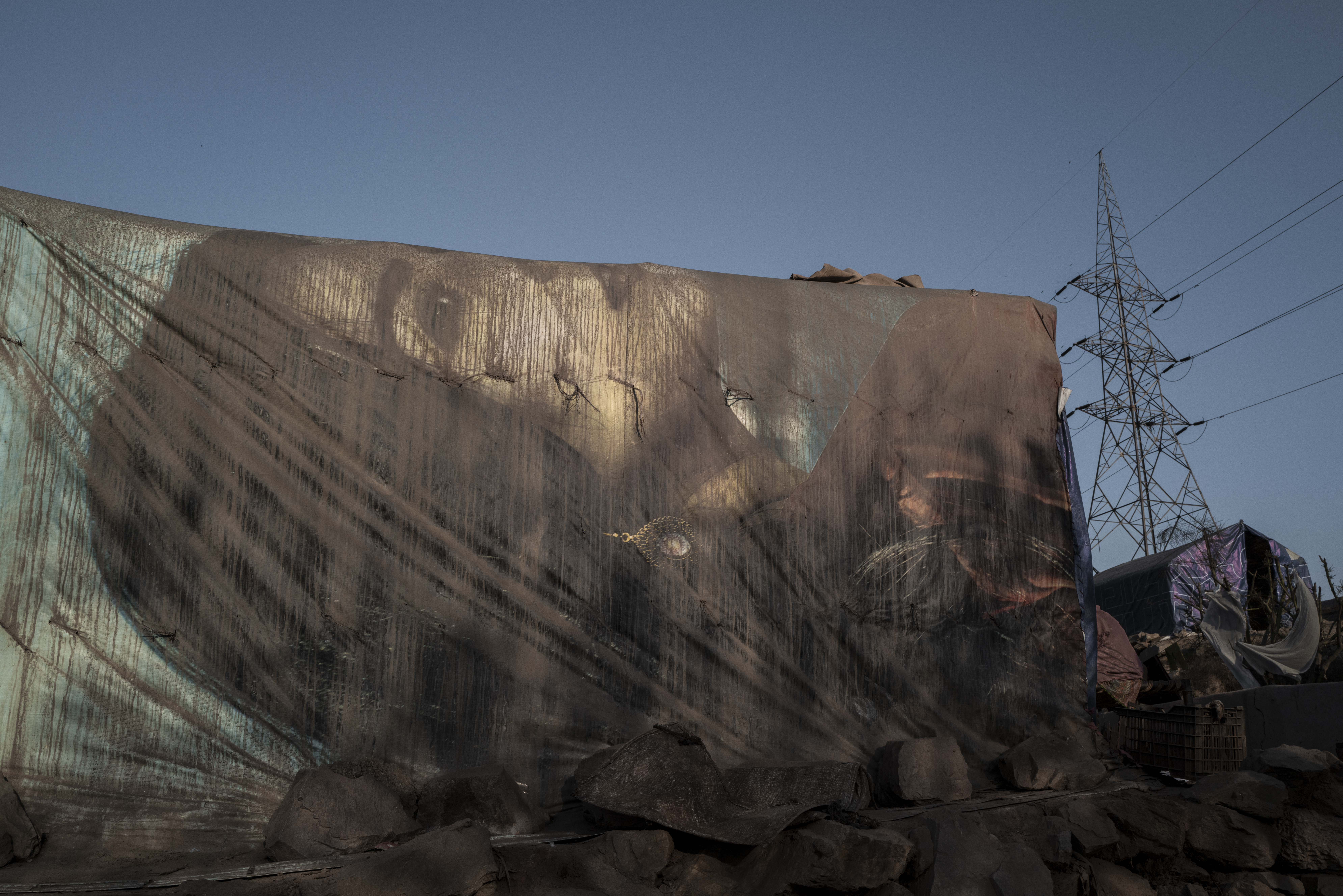
Lahore, PAKISTAN. On the outskirts of Lahore, dust and emission particles accumulate over a makeshift tent.
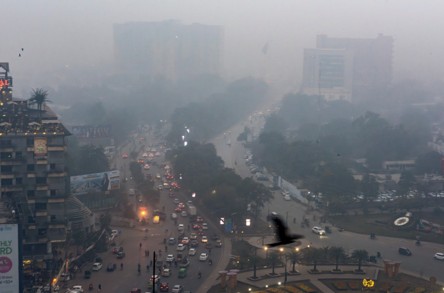
Lahore, PAKISTAN. 2022.
A view of Liberty Roundabout, a main junction in the city centre, clouded over with smog
Smog catches public attention every winter. But it is only one among several aspects of air-pollution in Lahore. The phenomena of smog is caused by temperature inversion where cooled polluted air gets trapped near the ground level and binds with moisture molecules.
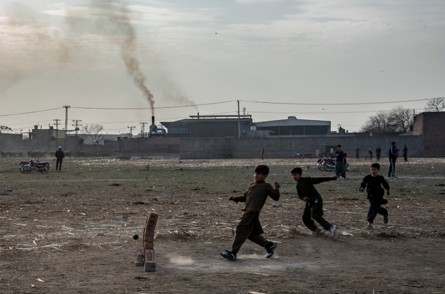
Lahore, PAKISTAN. 2023.
Children playing in a ground with unfiltered smoke in the background on a Sunday affiernoon when all such factories were required to stay shut, by law.
More pollution means more visits to hospitals. Exposure to air pollution is associated with higher blood pressure & asthma (Sughis et al., 2012; Aslam et al., 2022).
Considering Lahore’s persistent environmental pollution, pediatric respiratory illnesses occur at the cross-section of environment, class, gender, education, and urban geography.
The children depicted in these photographs are at the pulmonary ward of Gulab Devi Hospital, Lahore. They are not only patients but subjects shaped by overlapping structural inequalities that precede and extend beyond illness.
Most patients come from low-income neighborhoods where exposure to industrial and vehicular pollution is highest and public infrastructure is weakest. Although treatment is formally free, access to it is constrained by economic uncertainty; families reliant on daily wage labor delay hospital visits until conditions become severe, as seeking care requires forfeiting income and undertaking long, costly journeys across the city. These spatial and economic barriers transform healthcare into an emergency-only resource.
Care within the hospital is overwhelmingly gendered. Children are accompanied almost exclusively by mothers or sisters, reflecting the unequal distribution of unpaid care labor. Resource scarcity forces each child to bring a personal blanket, a small but telling marker of institutional neglect. At the same time, that personal blanket becomes the only piece of “home” in a place as terrifying as a hospital in the mind of a child.
Such illnesses disrupt schooling and cognitive development, ex-acerbating learning inequality for children already confined to under-resourced educational systems.
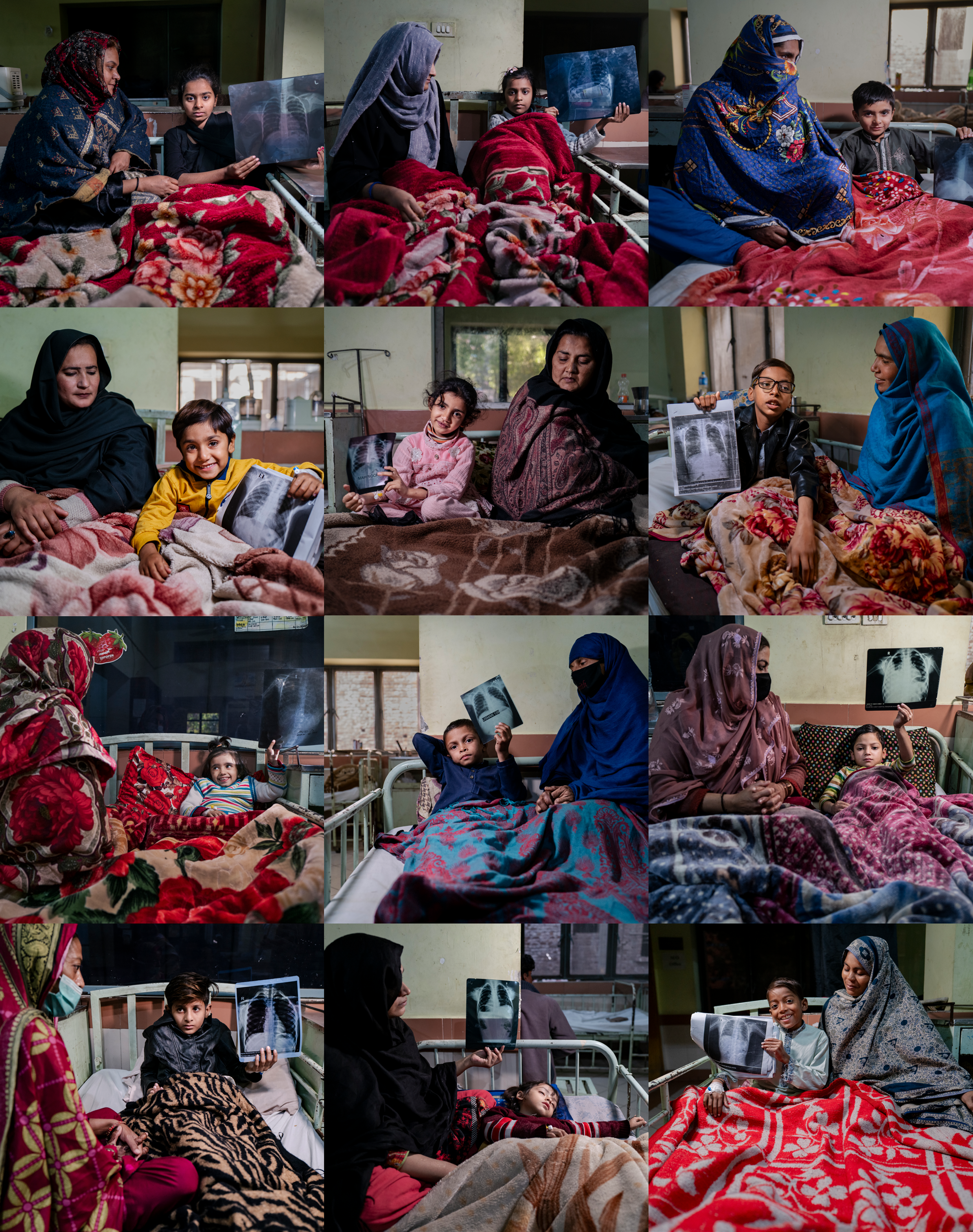
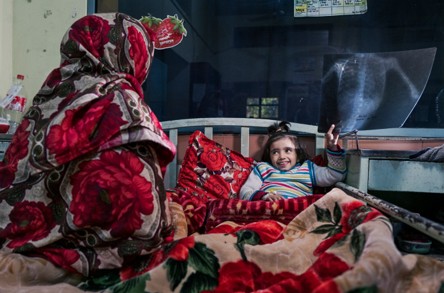
Lahore, PAKISTAN. 2022.
7-year old Eman Fatima holding her chest x-ray, accompanied by her mother, in the pulmonary ward of Gulab Devi Hospital, a “trust” hospital in Lahore with limited funding from the government, relying mainly on donations.
Eman Fatima has been suffering from pulmonary damage & infections resulting from air-pollution. She lives in the ‘China Scheme’ area, which is full of scrap metal foundries and small to medium scale factories.
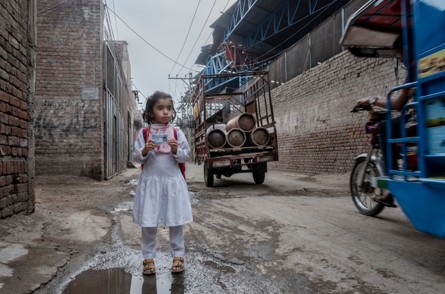
Lahore, PAKISTAN. 2023.
Eman Fatima in her neighbourhood affier recovery from pulmonary illnesses. She is holding her school identity card, surrounded by scrap-iron furnaces & factories. The air in her area is known to be toxic.
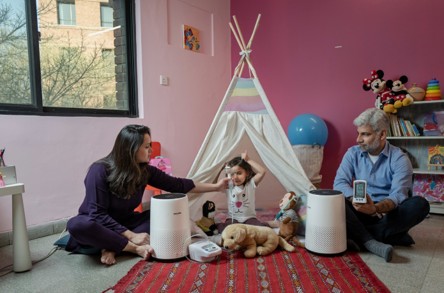
Lahore, PAKISTAN. 2023.
Dr. Aurangzeb Haneef holding an air-quality monitor, with his asthmatic daughter, Mareha, sitting between two air-purifiers, while his wife Mehwish, also asthmatic, offiers a nebulizer to their daughter.
Despite living in an upper-class part of the city, Dr. Aurangzeb’s family has suffered constant sickness due to air pollution. During the peak pollution season of 2022-2023, his daughter had two major asthma attacks and missed about half of her school days.
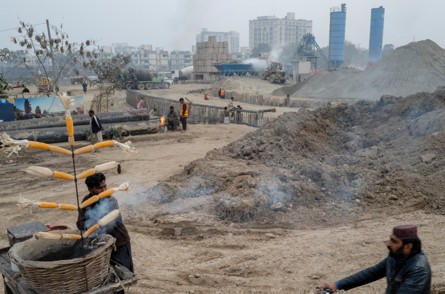
Lahore, PAKISTAN. 2023
Construction funded by the government at Kalma Chowk, a busy central area of Lahore.
Construction dust is one of the biggest sources of air-pollution here. All construction sites in the city produce Environmental Impact Assessment (EIA) reports which are then approved by the Environment Protection Department Punjab. They always promise to prevent or mitigate environmental damage.
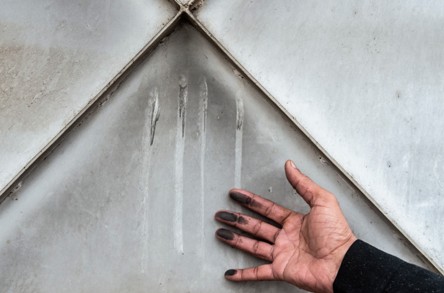
Lahore, Pakistan 2022.
A resident of a highly-affiected area showing the thick layer of grime on a house-gate, caused by the accumulation of pollutant particles.
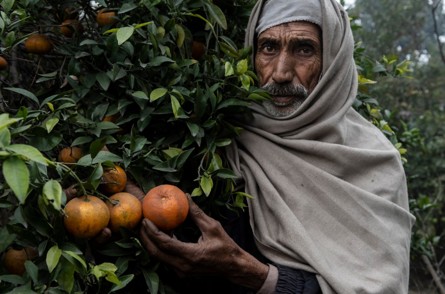
Lahore, PAKISTAN. 2023
A worker of a scrap-iron foundry, retired due to breathing ailments and now working as a gardener. He shows oranges covered with industrial soot and emission particles.
Quitting such factory work often doesn’t bring sufficient relief because many workers live close to industrial areas due to lower housing costs.
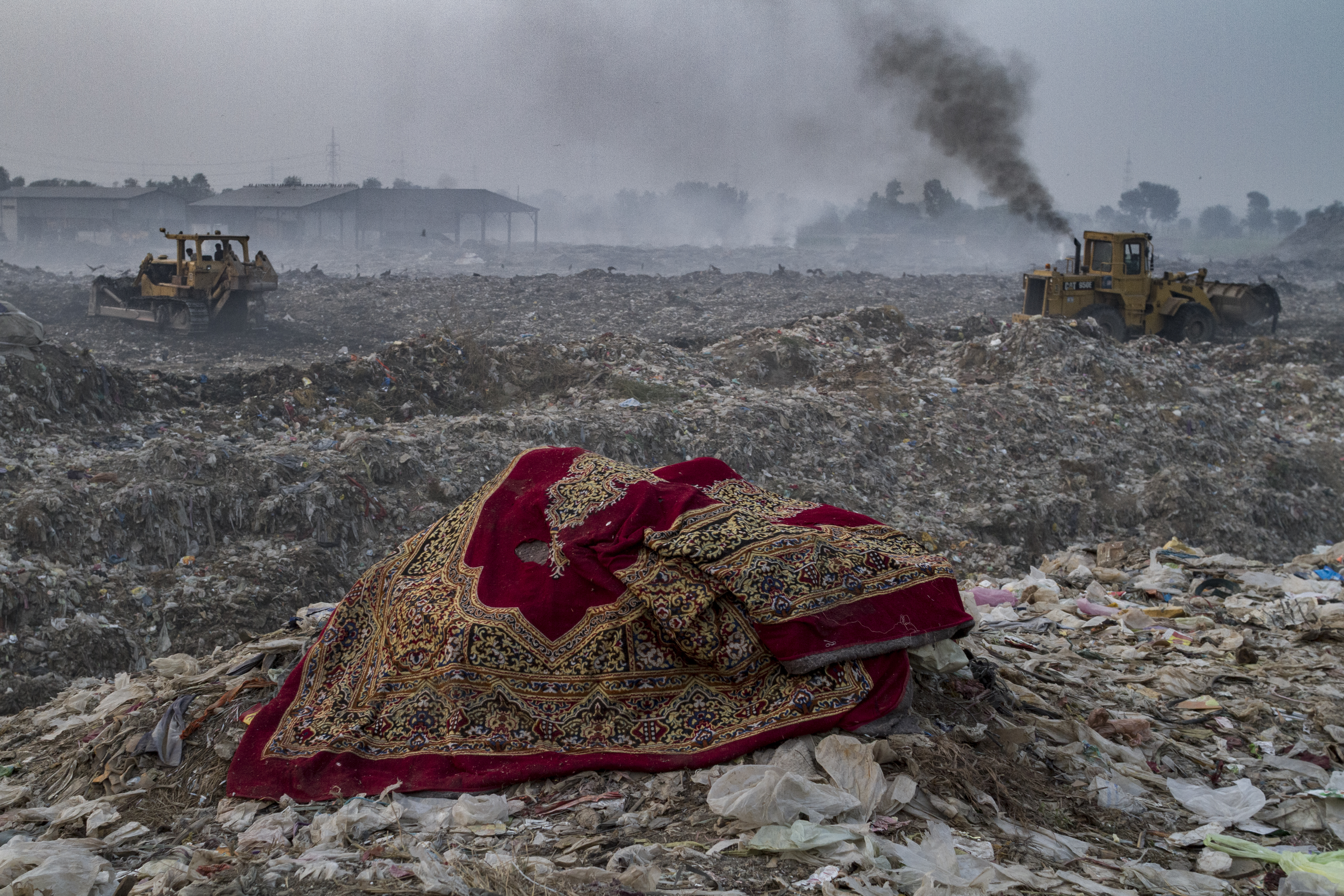
Mehmood Booti open-dump Lahore, PAKISTAN. 2011.
A view into the city’s main landfill site, where a garbage collector had covered their possessions with a carpet. Here, the daily burning of refuse, uncovered waste piles, and haphazard sorting routines generate dense airborne particulate matter, soot, and harmful gases, polluting groundwater with heavy metals and compounding Lahore’s already severe air quality crisis and exposing nearby residents and workers to toxic emissions.
Large swathes of municipal waste are often left to decompose and burn in the open, releasing methane, carbon monoxide, and other pollutants into the atmosphere. After decades of criticism, authorities began to treat the Mehmood Booti legacy dump as both a health hazard and a climate risk site, moving toward closure and remediation: today a reported 14 million tons of waste at the Mehmood Booti footprint are being buried, while the city administration, in partnership with development actors like Ravi Urban Development Authority, is advancing plans for a solar park and re-urbanised land.
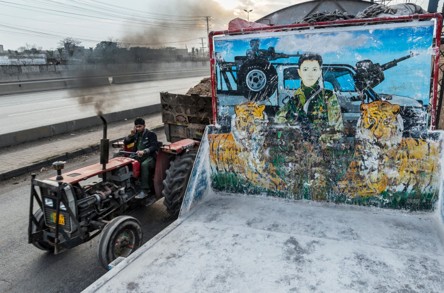
Lahore, PAKISTAN. 2023.
A diesel tractor passing by a parked truck with a painted back wall. Vehicular emissions constitute one of the major causes of smog.
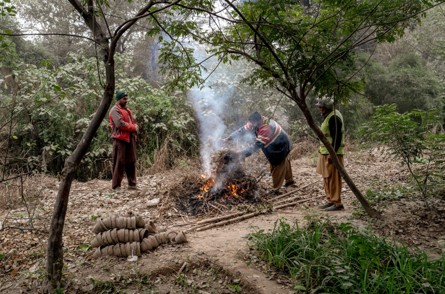
Lahore, PAKISTAN. 2022.
Employees of PHA burning dry leaves and branches. The ground workers say that they are too under-paid to compost the branches & leaves they collect.
There is a recently-imposed fine of ~$725 (PKR 200,000) for burning such fires. Since that announcement, these fires are now conducted away from public areas, composting is still an unexplored alternative.
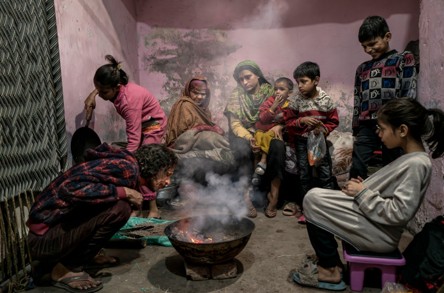
Lahore, PAKISTAN. 2022.
Burning plastic clippings for heat in the winter, a family in their 2-room home, waits for warmth to accumulate in an unventilated and uninsulated house
References:
01. Aslam, , Sharif, F., Baqar, M., Nizami, A.-S., & Ashraf, U. (2022, February 26). Role of ambient air pollution in asthma spread among various population groups of Lahore City: a case study. Environmental Science and Pollution Research, 30, 8682–8697. Springer Nature Link. https://link.springer.com/ article/10.1007/s11356-022-19086-1
02. Sughis, , Nawrot, T. S., Ihsan-ul-Haque, S., Amjad, A., & Nemery, B. (2012, May 25). Blood pressure and particulate air pollution in schoolchildren of Lahore, Pakistan. BMC Public Health, 12(378). Springer Nature Link. https://link. springer.com/article/10.1186/1471-2458-12-378