

Abstract
When heritage becomes playable, history becomes participatory. We have long utilised architecture in films and games, but can we now use gaming to explore and preserve untapped heritage sites? In Pakistan, where political, social and geographic constraints result in limited access to heritage, the digital realm offers an alternate venue for encountering and experiencing what is otherwise obscured. A question arises: how can heritage conservation be reframed as a creative and participatory act that integrates exploration and accessibility within a single platform?
By positioning gamification and virtual world-building as methods of engagement, we explore how digitized heritage can shift from static archives to interactive experiences. These digitized environments are envisioned not merely as archives, but as living, navigable universes-educational, speculative, and experiential in nature. This approach expands heritage preservation into the realm of virtual world-building, using architecture as a vessel to both conserve and reimagine cultural memory.
The 21st century brings us at the intersection of cultural revitalization with a vast digital landscape, exploring the past with gamified elements of the future. This body of work will pursue cultural exploration through a speculative prototype, where research and visuals will inform our creative inquiry into interactive archives for cultural heritage in Pakistan. While the implications are broad, through virtual world-building and epistemic research, this paper focuses primarily on architectural accessibility and digital archival.
Keywords: Digital heritage, gamification, world-building, explorability
Introduction
The tales of lives lived in the heart of an ancestral city passed down through generations, the first time you felt the weight of history while wandering through narrow alleys, surrounded by weathered stone, crumbling structures, and the awe of standing beneath the shadow of an ancient monument are some of the many moments etched into our collective memory that anchor our personal narratives within an ever-evolving cultural landscape. As these physical sites become increasingly obscured, these memories risk becoming fragments of a world we can no longer reach.
Culture is the synthesis of the tangible and the intangible, wherein the values of a society are materialised in objects, sites, practices, and oral tradition. This synthesis ensures that a physical site is not merely stone, clay, or brick, but a vessel for collective memory. Folklore, traditions, and heritage sites function as cultural pivots, yet within an ever-changing world, they require mechanisms that not only support their conservation, but their archiving in ways that record their existence and significance as well as promote accessibility and exportability. With the advent of technology and its integration into preservation efforts, such mechanisms have increasingly shifted toward digital interfaces, allowing digital forms of the physical world to exist. Cultural heritage sites, when reconstituted as digital archives, reshape how cultural ecosystems are preserved by experts, and encountered, consumed, and understood by the masses. These mechanisms help create a framework for preserving cultural heritage within the expanding urban configuration of our cities. However, despite the availability of technology and expertise, cultural heritage in Pakistan remains the subject of conservation efforts (some more successful than others), with various sites at risk of being lost
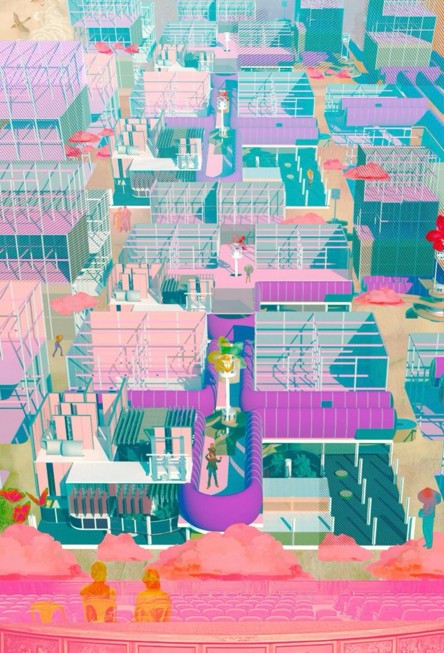
Fig. 1 A visualisation commenting on architectural explorability in videogame urban dynamics. The first step towards exploring capacity of videogame architecture
– Designed by Mahnoor Zahid
due to environmental degradation, terrorism, vandalism, and encroachment. Several heritage sites are either untapped ruins or are simply inaccessible to the public, resulting in the gradual erosion of cultural memory and collective affluence.
To address these challenges, this research positions gamification and virtual world-building as critical methods of engagement. By transforming digitised heritage from static archives into interactive, navigable universes, we can transition from a passive observation of the past to a participatory experience of the present. This paper utilises research-driven gamification to archive and reimagine Pakistan’s cultural memory. Through this digital medium, history is no longer a stationary relic but a playable narrative, capable of digitally preserving structure beyond physical repair while facilitating access for those previously excluded by geographical, social, and institutional constraints. This inquiry sets a critical question in motion: How can heritage conservation be reframed as a creative and participatory act that integrates explorability and accessibility within a single platform?
Answering this question requires situating the inquiry within a broader landscape of digital precedents; a fabric of participatory frameworks and platforms that collectively establish virtual world-building as an operative cultural system. This research identifies this landscape as the ‘Existing Grid’, where emerging design practices are already utilising digital media to promote the engagement of both tangible and intangible heritage.
Existing Grid
The Existing Grid represents a paradigm where heritage preservation in the 21st century is progressively shifting towards digitally experimental frameworks that focus on the digitisation and promotion of cultural assets (both tangible and intangible heritage). Within this landscape, virtual world-building has evolved into an infrastructural asset, particularly within sandbox and open-world environments. By leveraging these platforms, the digital territory functions as a navigable universe that transcends geographical borders, the limitations of distance, and other restrictions (social and institutional). Archives becoming interactive holds the potential to provide accessibility for the masses to the country’s heritage, and in turn educating people about the rich history, creating awareness for the need for protecting cultural memory, and prompting people to take ownership of their own heritage by promoting community participation in the preservation process. This research categorises the existing grid into three primary modes of engagement to understand complex digital mechanics: Speculative Archiving, Commercial Reconstruction, and Global Accessibility Platforms.
Speculative Archives and Participatory Discourse
This potential has been explored and implemented by studios such as Blockworks, a design collective that creates speculative architectural projects in Minecraft. Their project, the Uncensored Library (2020)-a virtual library hosted within Minecraft (2011), a 3D sandbox videogame preserves and disseminates censored journalism. As stated in its release, “Even where media is blocked or manipulated, Minecraft remains accessible: the Uncensored Library uses this loophole to make censored journalism available” (Reporters Without Borders, 2020). This project establishes a precedent for speculative reconstruction as a tool for cultural and political discourse, demonstrating how game environments can function as alternative archival spaces that empower the agency of the user and promote their engagement. Similar methodologies are evident in the reconstruction of Charles Booth’s London (2025), developed in partnership with the London School of Economics, which produces a digital twin of historic maps to enable educational exploration by creating a digital twin of historic ‘Poverty Maps’ within Minecraft. Such projects exemplify how participatory open-world environments enable educational exploration while preserving the socio-spatial narratives of specific historical periods.
Commercial Reconstruction and Historical Continuity
Commercial game studios have likewise engaged in heritage reconstruction at scale. Ubisoft’s Assassin’s Creed series (2007-2025) embeds historically researched architectural environments within playable cityscapes, reconstructing sites at their temporal peaks and allowing players to engage with lived histories through exploration. These environments function as more than just visual backdrops; they form a dialogue surrounding spatial narratives that maintains historical continuity and a sense of identity. Additionally, Ubisoft’s digital reconstruction of Notre Dame Cathedral was offered to be used as a reference during the physical reconstruction of the Cathedral following the 2019 fire (Assassin’s Creed maker*, 2019). The model originally digitised for Assassin’s Creed Unity (2014) functioned as an infrastructural asset for virtual tourist exploration while the physical site remained under construction (Save Notre Dame*, 2019).
Global Accessibility and Cultural Unification
Platforms like CyArk, Google Arts and Culture have created online mediums accessible via mobile applications and the internet. CyArk’s 3D virtual tours have made the world’s cultural heritage accessible on a singular webpage, positioning digital media not as a segregator of history, but rather as a unifier of diverse cultures, as indicated by their tagline, “Globally recognized places that belong to all of humanity”. Through a team of professionals, they enable documentation and archiving to create “digital records” and precise 3D replicas that aim to guide restorations and be utilised during disaster management.
While digital space and cultural heritage operate as distinct domains, their intersection constitutes a scalable and sustainable cultural infrastructure with long-term implications for access, preservation, and education as showcased by the Existing Grid.
Limitations
Digital media creates unprecedented accessibility, but it also opens cultural heritage to a new layer of risk: narrative bias. To create playable archives, we must establish a framework of transparent, research informed storytelling that acknowledges the risk of a conscious or unconscious rewriting of history. In the work of studios like Ubisoft, the inclusion of history specialists is essential to ensure historical accuracy (Games as Historical Immersion*, 2026). Digital archives must not simply preserve the physical structure, but also the history, narrative, and culture associated with it. Without these elements, the sites are subject to distortions that can be detrimental to the collective memory of an area.
The risk of creating an inaccurate, playable archive necessitates the foundation of a rudimentary framework, one that ensures historical research, archiving, and narrative storytelling are grounded and documented facts. In many contemporary media betrayals, historical environments are often adapted to prioritise aesthetic appeal over factual accuracy. However, the portrayal of Pakistani heritage must prioritise rigorous research since Pakistani heritage has not yet had considerable global exposure. The inaccurate archival can be detrimental to the history and portrayal of local heritage. The methodology to ensure this accuracy depends on fact-checking every narrative and research element, consolidated by human historians, ensuring that even speculative elements are grounded in historical data.
It is inevitable that through gamification of cultural heritage, the perception of the structures will change. With several sites being inaccessible in Pakistan, digital exposure creates opportunities for discourse and tourism. The motive is to facilitate exposure to existing heritage, not replace physical exploration; what is explored digitally can reduce ambiguity surrounding physical sites. Online digital traction strengthens the potential for on-site restoration and preserving local ecology. Ultimately, access to digital media leads to inherent exposure, serving as a vital tool in preventing the erasure of historical memory.
While the goal is accessibility, it is important to note that many audiences, including students, women, researchers, and those with disabilities still face barriers to accessing cultural heritage. A digital platform is particularly useful for these groups, although the technological barriers must be acknowledged as a limiting factor. Internationally, over the years, cultural heritage has gained traction as a tourist commodity. As many nations globally have already begun digitising and archiving their cultural heritage, Pakistan’s efforts in conservation and promoting tourism can deeply benefit from creating these playable, interactive archives, letting the world experience Pakistan’s unique cultural heritage digitally and attract tourists to take the trip and explore in-person.
However, implementing these mechanisms for archiving requires more than technical adoption. It calls for a dedicated conceptual territory to be established where the challenges of narrative bias and the need for factual accuracy, transparency and diligent preservation can be addressed. For this purpose, this paper coins the term ‘White World’, as a neutral digital canvas that dissolves the constraints of physical time, space, and other restrictions to provide the capacity for speculative reconstruction grounded in historical research. By establishing this conceptual space, the project moves beyond the global ‘Existing Grid’ of technology and digital archiving towards a framework where history and heritage are not a stationary relic but a transparent and participatory narrative.

Fig 2. An empty grid depicting the neutral digital canvas ‘White World’ in the virtual realm-Designed by Mahnoor Zahid
White World
The ‘White World’ is defined in this study as a neutral digital canvas which serves as an empty architectural site within the virtual realm that provides space necessary for the digital preservation of culture without limitations of physical degradation. Unlike the ‘Existing Grid’ which consists of established industry precedents, the White World serves as an epistemic instrument designed to reshape our understanding of Pakistan’s history through interaction. Here, speculative reconstruction is utilised not to distort the past, but as a research informed methodology to fill the gaps where physical evidence is lost, irreparable, or at risk of being lost. The White World creates a resilient foundation for Pakistan’s cultural heritage to be digitally preserved and experienced by a local as well as a global audience.
The conceptual framework of the white world is implemented through research driven gamification, which is a methodology that translates primary architectural mapping, archival data, and ethnographic folklore into interactive gaming space. In an era defined by the attention economy, where traditional archives often remain stationary, inaccessible, and seemingly unexciting to the masses, gamification transforms heritage engagement into an active and participatory experience. These interactive systems act as an epistemic instrument, reshaping our understanding of history by allowing it to be encountered as an embodied experience, rather than a passive recollection.
By utilising gamification, this project aims for universal accessibility, allowing users, including students, women, people with disabilities et cetera, to engage with heritage beyond geographical, social, or physical borders. This approach does not seek to replace physical exploration, but rather to narrate interactive stories, preserve irreparable structures, and promote culture and community engagement in a way that emulates experience of the ancient eras.
This research introduces ‘Forgotten Worlds’- a speculative research prototype designed to archive and reimagine Pakistan’s cultural memory. The following chapter details the construction of this world, presenting a montage of cultural heritage sites on a singular digital plane. It outlines the game’s core architecture from its diverse heritage sites to the specific mechanics (including architectural modelling, historical integration, narrative side quests, environmental storytelling), transforming these sites into living, interactive archives.
Gameplay: The Forgotten Worlds
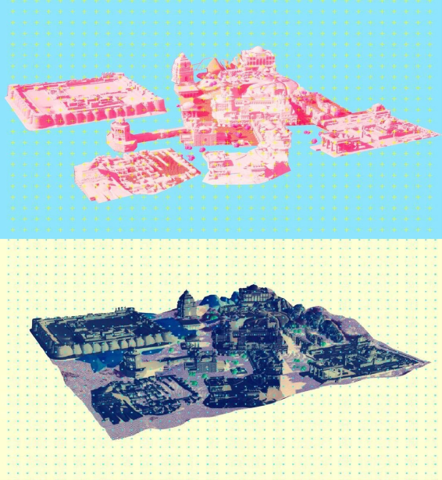
Fig 3. Axonometric of ‘Forgotten Worlds’ – Designed by Mahnoor Zahid
The Forgotten Worlds is a proposal for a game based on Pakistan’s cultural heritage, a virtual realm built to explore heritage through gamification. The premise of this realm is to create an environment in which players navigate through heritage sites, cultures, and urban spaces, experiencing these sites during their prime. It comprises of an amalgamation of the many cultures that form Pakistan’s cultural landscape. Building on this diversity, the gameplay creates an environment for exploration and historic learning by embedding the players within different eras, nurturing curiosity. This innate curiosity to learn of the land’s past is what Forgotten Worlds represents.
The game follows the narrative of player ‘A’, who, intrigued by the world’s heritage, seeks to learn as much as s/he can. S/he reads, consumes media, plays games, studies satellite maps, all to understand the growth of humankind. Although, his/her efforts flicker whenever they cross Pakistan’s territorial lines, s/he wonder about the state of heritage archival when a country so integrated within humankind’s evolution has such a small digital footprint. Several of the heritage sites being inaccessible due to geography, bureaucratic red tape, and public hesitation have made this learning even more difficult.
One night during his/her internet deep dive, s/he comes across a webpage ‘forgottenworlds.untitled.com’. S/he’s curious so s/ he clicks the link. Alas, s/he is swallowed whole into her laptop screen. S/he looks around, startled; s/he’s in a white world, surrounded by a grid that spans as far as s/he can see. S/he walks ahead; his/her movement triggers the opening of a portal. A sign reads ‘Forgotten Worlds: Walk through the portal to start exploring’. Startled as s/he may be, s/he enters through the portal, intrigued by whatever wonders exist on the other side, a dream within a dream, some might philosophise. As his/her new surroundings evolve around him/her, s/he finds herself in the middle of a forest. The forest glitches and a set of instructions play out in front of him/her. ‘The cultural heritage of your country is at your disposal. To explore, continue the game. Each level will take you to one heritage site. Your quests will be given to you. Upon completion, a portal will appear, ready to take you to another level. Each level is an era with its relics and sites archived, tucked away for you to explore and interact with. Once you have completed all the levels, you will be able to explore the entire realm. You can go through portals at will, uncover the meaning of old frescoes, fly at birds-eye view, collect relics, and do much more. To proceed, walk past this message’. S/he walks past the message, and the game begins.
Fig 4. Web interface for ‘The Forgotten Worlds’ – Designed by Mahnoor Zahid
Game Narrative:
The player’s journey is designed as a chronological discovery of Pakistan’s cultural lineage using the “White World” as a starting hub and portals to overcome the “geographical constraints and institutional restrictions” that limit access in the physical world.
The journey begins in the White World, described as a neutral space, an empty architectural site. Here, the player dissolves the constraints of time and space to design their personalised avatar, making them legible within the navigable universe. From this space, the portal appears taking the player on their journey, connecting the otherwise scattered cultural sites into a singular digital plane.
Player A’s journey:
The game progresses through a series of levels as instructed to A. The portals connect each cultural heritage site to the other forming an urban fabric of an interconnected realm. The player’s journey connects the sites chronologically, starting from Mohenjo Daro in 2500 BCE and journeying all through the end to Jamia Masjid in 1903. The narrative continues; the quests are laid out for A to accomplish. Each quest and side-quest is built for A to learn as she explores.
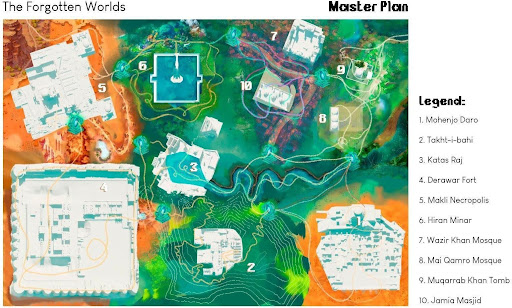
Fig 5. Master plan for ‘The Forgotten Worlds’ showcasing heritage sites on a single digital plane – Designed by Mahnoor
Player Progression:
Mohenjo Daro is the first site of the journey. The player enters the first portal to discover the archaeological ruins of the Indus Valley. The focus is on urban settlement where they must explore the architectural features of the site from the elaborate drainage system to baked bricks to understand the civilization’s administrative and economic abilities. Upon completion of the quest at Mohenjo Daro, a portal appears taking the player to the high hills of Mardan to explore the most complete Buddhist monastery in Pakistan, Takht-i-bahi. Here the gameplay involves navigating through monastic cells and studying the stone patterns. Moving through a portal to the Salt Range, a new geographical location, the player engages with Katas Raj, a Hindu pilgrimage site. This site introduces a new form of discovery for the player, exploration through water and land. As the player completes their quests at Katas Raj, the journey shifts to the Cholistan Desert, Derawar Fort. The player uses a portal to access the 40 bastions of the fort, navigating ancient mercantile and pilgrimage routes from Central Asia.
The quest here includes the safety of the mercantile routes from Central Asia to the heartland of the Sub-continent. To ensure historical continuity, they must tackle an environmental state for the safe retrieval of trade routes using learning scrolls embedded within fort walls. Proceeding, the portals bridge the gap to Sindh’s funerary architecture of Makli Necropolis. The player investigates the fusion of diverse influences, such as Rajput pillar canopies within Islamic family graveyards, identifying how diverse cultural threads assemble into a single fabric. The portal then opens to Hiran Minar, a structure of geometric splendour where the balance of built and natural environment leads the player to identify the Mughal geometric patterns. This is done through a quest to calibrate Hiran Minar’s geometry by treating each space as a part of a puzzle. Our focus on historic continuity highlights how each site should be viewed correctly to carry on as cultural memory. As the portals open, taking our player to the Gakhar era of Mai Qamro Mosque, the player partakes in clan history by finding the hidden poison vial that Mai Qamro used to poison her husband, Hathi Khan. The journey continues into the Walled City of Lahore. The portal places the player at the intersection of major routes and bazaars where they document frescoes, geometry, and find hidden architectural gems that are placed within Wazir Khan Mosque. As we approach our last two sites, our journey closes on a more integrated note. At Muqarrab Khan Tomb, the player must recover building blocks of the tomb from all subsequent heritage sites and help build the tomb. This inclusion in historical acts prompts the player to view history as a participatory act. Finally, the last portal opens at Jamia Mosque in Rawalpindi. Our player has to embed him/herself within the urban fabric, finding scrolls, relics that reveal the structure’s history. This final act positions the player as the ‘researcher’ of cultural heritage, imparting lessons that serves the learning outcome of ‘The Forgotten Worlds’.
Historical accuracy and advisory
Historical accuracy is one of the core components of the proposal. Since the game’s purpose is to bridge the gap between cultural history and the present, the historical advisory needs to be prioritised. This will comprise of two significant layers:
Historically-accurate game environment: The environment is the core of the game. This includes the vegetation around the heritage sites as well as the trade, customs, and bazaars, comprising of all the urban elements a native would find around the heritage sites. If a heritage site was at the centre of its social structure during its prime, then for the game to be historically accurate, the design must convey the same urban-socio hierarchy.
Historically-accurate game narrative: The narrative is the story-line along which the game lets the player navigate. While the narrative will be discussed on a further level, its historical accuracy is the main component upon which the legitimacy for the game is built. Historical advisors, archaeologists, and era-specific historians have to be consulted for a history-sensitive game to come to fruition.
Architectural modelling
The architectural sites that mark each era, dynasty, and their culture are far and wide. With their digital twins reconstructed in the virtual realm, the archival of history becomes a less intimidating act. The photogrammetric mapping of sites near ruin with accurate environmental storytelling becomes a tool for experiencing heritage beyond decay. The Forgotten Worlds is essentially an archival of architectural heritage sites that have been modelled and restored digitally with accuracy.
Character and regional diversity development
An integral part of Forgotten Worlds are the non-playable characters that showcase the culture of each level. Linking to historical accuracy, much of the knowledge of the ancestral ways of life comes from verbal communication between the people of the area now and historians who fact-check the statements. Their attire, social construct, behaviour, and livelihood are some of the aspects that build accurate data for non-playable character development. In civilizations such as the Gandhara, the religious beliefs, and foreign relations also impact the sort of characters that are found within the level.
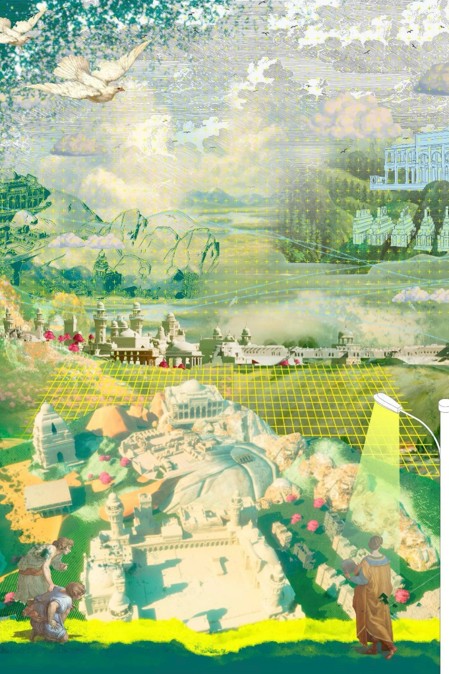
Fig 6. Prototype Visualisation – Designed by Mahnoor Zahid
Environmental storytelling
One of the most important considerations for the virtual realm in Forgotten Worlds is the environment. Most of these heritage sites are located across considerable distances, but in the game, they’re proposed to be on a singular grid, accessible via portals. This narrative is important to the paper since the portals connecting the heritage sites and their respective eras to each other enable to cultural accessibility. The environment needs to extend beyond the narration of each era; it should embody the spirit of the era. Rebuilding the urban social structure of the era, the landscaping, and the marketplaces creates a realistic experience of each site. One of the core components of environmental storytelling are the built pathways. This includes on-ground exploration, rooftop manoeuvring, and off-ground trekking. The pathways help the player navigate between their main and side quests, providing the design of the player’s journey.
Rituals, culture, and interactive elements
Between the necropolis at Makli and the pilgrimage rituals at Katas Raj, the cultures that existed around each heritage site are unique. They also form the ground for side quests in Forgotten Worlds. For ‘A’ to explore each culture and truly learn, s/he has to complete a set of quests. The quests range from intellectual pursuits to small tasks as the player embark on their journey. For exploration to expand beyond the quests, objects of historical importance are to be made interactive. This means that the player can toggle the objects and learn more about them such as studying the drainage system of Mohenjo Daro, or understanding the hidden frescos in Masjid Wazir Khan.
Open-world exploration
On the completion of all levels including side quests, players gain access to the entire map. They can then wander through the portals and explore different heritage sites and learn about them. There will be interactive toggles through which the player can learn the history and architecture of each site
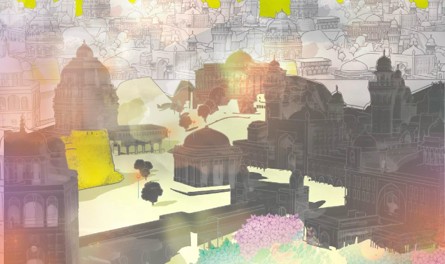
Fig 7. Visualisation for open-world exploration – Designed by Mahnoor Zahid
Intersectionality
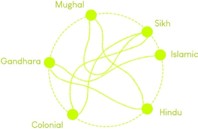
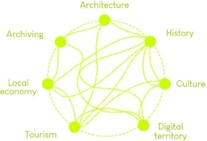
Fig 8. Intersectionality mapping – Designed by Mahnoor Zahid
We stand at the intersection of critical mediums, and pursuing cultural awareness can be made possible by situating these mediums across one another as tools of cultural awareness. Through research-driven gamification, these narratives can be situated within archives that operate as living heritage ecologies, spaces where memory, architecture, and interaction coexist beyond the limitations of physical preservation. As eras intersect, so should our cultural growth within the multi-temporal landscape of Pakistan.
Technology now operates at the precipice of emerging realities, and with each iteration, new worlds are created that allow these realities to unfold. Forgotten Worlds positions itself as both a call to action and a critical insight into the latent possibilities embedded within Pakistan’s cultural heritage. Gamification is not meant to replace actual exploration. Instead, it will narrate interactive stories, preserve irreparable structures, making exploration a playable and catalytic act that emulates the experience of ancient eras.
The intersection of historical, digital, and creative fields in the pursuit of cultural uplifting makes cross-disciplinary work not just a method of achieving results, but also of building community. Through cross-collaboration with different fields, a strengthened sense of community is achieved, or rather built. Furthermore, based on digital archives, research opportunities for young individuals increase. All in all, gamification of heritage aims for accessibility for all, beyond borders, economies, and immigration.
Conclusion
“Forgotten Worlds” redefines cultural heritage conservation in Pakistan by utilising gamification as a means of digital archiving, transforming static archives into a participatory, navigable universe. Thus, this provides players with an embodied experience by framing history as playable, providing accessibility through alternate means to heritage sites that are currently inaccessible or in ruins. Despite the limitations, the game has the potential to be an epistemic instrument that would reshape how we understand and interact with our cultural ecosystems. In addition, it can aid in giving global exposure to Pakistan’s rich and extensive cultural heritage, and in-turn, promote cultural tourism, be a venue for cross disciplinary collaboration, and international cooperative conservation efforts.
As articulated by the International Federation of Library Associations and Institutions in Digital Cultural Heritage: Theory and Practice (2024), “Digital technologies strengthen the educational function of cultural heritage by encouraging wider participation and enabling new modes of research, communication, and engagement.” While digital space and cultural heritage operate as distinct domains, their intersection constitutes a scalable and sustainable cultural infrastructure with long-term implications for access, preservation, and education. By utilising primal archival data and architectural mapping in research-driven gamification, we can prevent the erasure of historical memory and archive our heritage for decades to come.
Notes:
– The Forgotten Worlds was designed by the author on Unreal Engine 5 with 3D models of heritage sites generated via Meshy AI, an interactive modelling
– The Visuals were designed and illustrated on
References:
01. Ali, (2020, May 3). A forgotten tale: Bagh Jogian speaks of neglect, disinterest, threats from urbanisation. The News on Sunday. https://www. thenews.com.pk/tns/detail/652594-a-forgotten-tale
02. Booth’s, (2019). Blockworks. https://www.blockworks.uk/projects/ charlesbooth
03. Assassin’s Creed Shadows’ Cultural Discovery Codex Brings Players Closer to History of Feudal Japan. (2024). com; Assassins Creed Franchise. https://www.ubisoft.com/en-us/game/assassins-creed/ news/1dyQ1iTz8GNQQI469468Jq/assassins-creed-shadows-cultural-discovery-codex-brings-players-closer-to-history-of-feudal-japan
04. Charles Booth on Minecraffi | Charles Booth’s London. (2025). Charles Booth’s https://booth.lse.ac.uk/learn-more/minecraft
05. Digital Cultural Heritage: Theory and (2024, February 19). IFLA.
https://www.ifla.org/news/digital-cultural-heritage-theory-and-practice/
06. Discovery Tour by Ubisoffi: Teacher Learning Resources | Ubisoft (CA). (2026). Ubisoft.com; Assassins Creed Franchise. https://www.ubisoft.com/en-ca/game/ assassins-creed/discovery-tour?isSso=true&refreshStatus=noLoginData
07. Fattori, , McKenna, F., Rivera-Carlisle, J., Gould, A., & Thomas, I. (2025). Digital Cultural Heritage: Imagination, innovation and opportunity. https://doi. org/10.57884/h3dv-7q98
08. Games as Historical Immersion and Preservation: Creating Fun and Plausible Worlds for Players. (2026, May 3). Ubisoft.com. https://www.ubisoft.com/en-us/ news/ignt.60063/games-as-historical-immersion-and-preservation-creating-fun-and-plausible-worlds-for-players
09. Ibrahim, (2025, March 15). In Rawalpindi, century-old mosque blends history, architecture and faith to attract worshippers in Ramadan. Arab News. https://www.arabnews.com/node/2593671/pakistan
10. Notre-Dame fire: Assassin’s Creed’s maker pledges aid. (2019, April 17). BBC https://www.bbc.com/news/technology-47963835
11. Pearson, L., & Youkhana, S. (2022). Videogame Atlas: Mapping Interactive Worlds (1st ). Thames & Hudson.
12. Promoting Collective Memory and Heritage through Gaming – the Story (2015). Unesco.org. https://www.unesco.org/en/articles/promoting-collective-memory-and-heritage-through-gaming-story-yoldez
13. Reporters Without Borders. (2020). The Uncensored Library. https://www. com/en
14. Sousa, , & Haque, M. S. (2023). Transforming tourist maps to increase heritage awareness uses for gamification and serious games. In PERSUASIVE (Adjunct).
15. Supporting Notre-Dame de (n.d.). News.ubisoft.com. https://news.ubisoft.com/en-us/article/2Hh4JLkJ1GJIMEg0lk3Lfy/supporting-notre-dame-de-paris
16. Tourism Development Corporation of Punjab. (n.d.). Katas Raj (Karta Raj) Temples [Webpage]. Tourism Punjab. Retrieved February 3, 2026, from https:// punjab.gov.pk/kartas-raj
17. UNESCO World Heritage Centre. (2011). Buddhist Ruins of Takht-i-Bahi and Neighbouring City Remains at Sahr-i-Bahlol. https://whc.unesco.org/en/ list/140/
18. UNESCO World Heritage (2024). Archaeological Ruins at Moenjodaro. https://whc.unesco.org/en/list/138/
19. UNESCO World Heritage Centre. (n.d.). Chaukhandi Tombs, Karachi (Tentative List Entry No. 1287). https://whc.unesco.org/en/tentativelists/1287/
20. UNESCO World Heritage Centre. (n.d.). Derawar and the Desert Forts of Cholistan (Tentative List Entry No. 6108). https://whc.unesco.org/en/ tentativelists/6108/
21. UNESCO World Heritage Centre. (n.d.). Historical Monuments at Makli, Thatta (World Heritage List 143). https://whc.unesco.org/en/list/143/
22. Wazir Khan Mosqu (n.d.). Google Arts & Culture. https://artsandculture. google.com
23. 3D Modelling – Meshy. (n.d.). Workspace [3D modeling platform]. https://www.ai/workspace