
Recruitment
A Filipino-American curator visiting Vienna in 2022 had asked me if I knew why there were so many Filipino nurses in the city. This question made me think of Gina, the Filipino nurse I met when my partner needed knee surgery in 2010. She was my first Filipino contact on my new phone. I had just moved to Vienna.
What was not so clear to me then was that Gina was among a long line of nurses sent to Austria from the Philippines since 1973. “Was it Martial Law that drove them to flee?” asked the curator. That would have been my guess as well, but as further research brought to light, the deployment of Filipino nurses to Austria in 1973 was one of the very first organized, government-to-government arrangements for sending Filipino healthcare workers abroad under the Martial Law regime of Ferdinand Marcos Sr. and would be a key reference in the creation of the 1974 Labor Code (Presidential Decree No. 442) to formally institutionalize labor export. This facilitated the first wave of approximately 600 Filipino health care professionals, who worked in 14 different hospitals in Vienna. The Labor Code of 1974 formalized and legitimized the Philippine government’s role in labor migration. This was not accidental—it was a deliberate policy by the Marcos regime to reduce domestic unemployment, generate foreign exchange through remittances, and stabilize the economy during a time of political and economic upheaval (Martial Law).
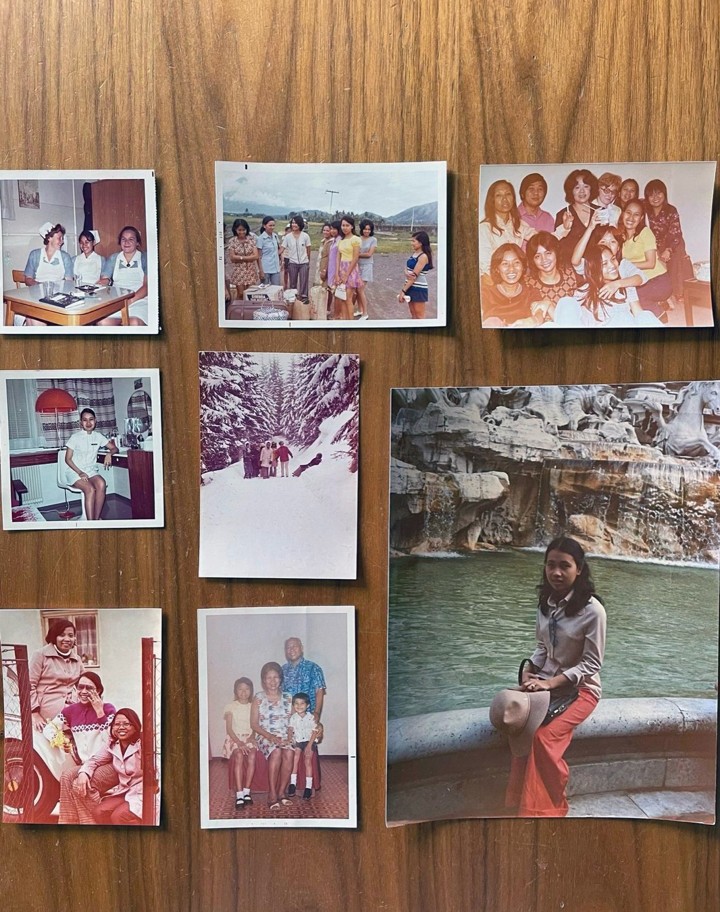
A collection of the Ante family photographs, around the first year of Francia moving to Austria from the Philippines (courtesy of the Ante family).
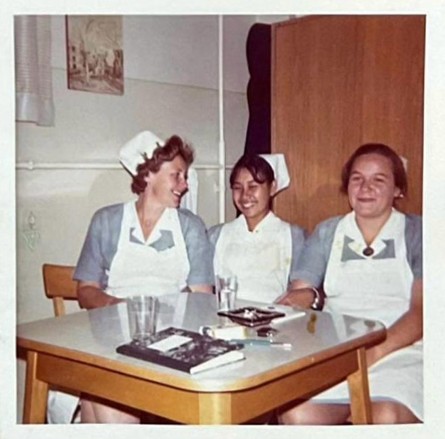
Francia (“Franzis” to her colleagues and “Fannie” to her family) seated center, during her first year in Vienna. She arrived in Austria on October 6, 1973, and would work at the Kaiserin Elizabeth Hospital, Surgery Room 6 till June 1981 (courtesy of the Ante family).
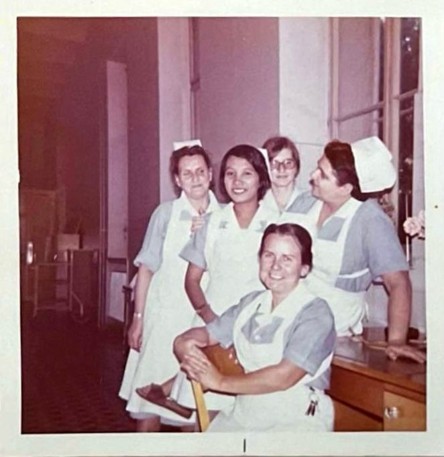
Standing centred with their nurse colleagues at the Kaiserin Elizabeth Hospital, ca.1970s (courtesy of the Ante family).
The first wave of Filipino health professionals was the start of a significant, visible, and thriving Filipino community in Vienna. In 2023, the Philippine Embassy in Austria and the City of Vienna signed a new agreement to further bring Filipino nurses to Vienna under an agreement called the Memorandum of Understanding (MOU) that encouraged a new wave of recruitment between the Philippines and the Federal State of Vienna and the Austrian Federal Economic Chamber. The agreement comes exactly
50 years after the signing of a similar agreement between Manila and Vienna, this time under the presidency of Ferdinand Marcos’s son, Ferdinand “Bongbong” Marcos, Jr.
Relations
In his work Traité du Tout-Monde, Caribbean poet and philosopher Édouard Glissant coins the term archipelagic thinking to reassess the insularity and heaviness of “continental thought”. For archipelagic sea-faring people, the sea does not constitute a barrier, but rather a connective tissue crossed by perpetual flows of exchange. Does archipelagic thinking, then also allow us to think of language, identity, and culture in terms of flows?
Glissant’s coined term not only touched on a geographic familiarity but also a certain longing, being a child of an archipelago myself. I could not help but think it funny how after growing up on an island, I have ended up living in a land-locked country, Austria. I chose to live in Vienna, almost as much as the nurses who came here to work did: it was somewhat through luck and chance and a search for other possibilities, the same sense of adventure and willfulness borne of seeing distance as just another sea-crossing. Does our affinity with the sea inform us differently? I can’t help but ask this in a land where the Alps tower over us. Glissant’s call for a reassessment of “continental thought” and the insularity within this mode of thinking is a clear attempt to open a discursive dialectic, to propose multitudes as a counter-point, as a way to describe being constituted by many different flows and exchanges, of language, culture, dispositions, and ways of being. Archipelagic thinking accords with the elements of the world that spread out in archipelagos, precisely these sorts of diversity in space, that nevertheless bring shores together and ally horizons. We have become aware of how much continental density has been weighing us down in the glorious systematic thinking that has governed the History of humanities, but that is no longer adequate to our explosions, our histories and our no less glorious wanderings (Glissant,1997).
I found our shared situated-ness of both being migrants and transients in Vienna, was the starting point for this exploration into a processual and open-ended “becoming” found in archipelagic thought. The Filipino Diaspora is quantified by those who’ve left the Philippines: we count the number of nurses we’ve sent abroad, the number of sea-farers, engineers, nannies, cruise ship workers, caregivers, occupational and physical therapists, contracts issued by various recruitment agencies and the legal frameworks that account for employment standards, labor relations, social welfare, and occupational safety. But the accounting is in one direction: a-here-to-there. There is a tally of Filipino citizens who leave (and perhaps return) but there is no accounting for those who choose to stay ‘abroad’ and the families and connections that root in this elsewhere. This work, that I shall introduce shortly, is about this elsewhere, the nebulous space that holds both the imagination and texture of ‘home’ and the desire lines that trace back to where this longing lays—perhaps a physical place: a hometown, a grandmother’s lap, or the backyard guava tree—or one that lives brightly only in the mind’s eye, no matter where one may find themselves.
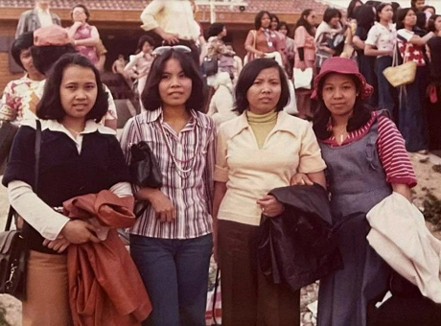
Fannie’s cohort of Filipino nurses who arrived in Vienna together celebrating “Philippine Independence Day” in Austria, ca. 1970s (courtesy of the Ante family).
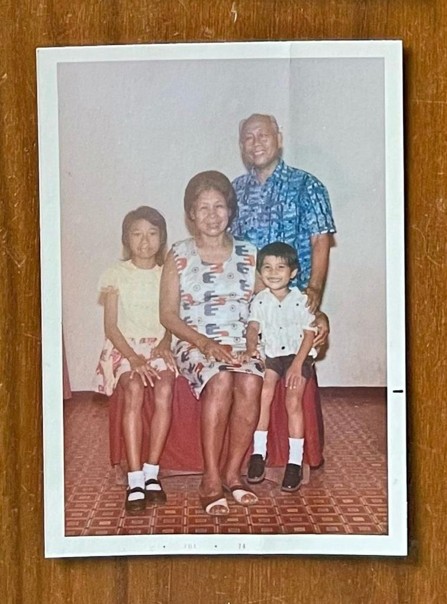
Fannie’s mother and father together with younger siblings. A photograph sent to Fannie from the Philippines dated December 10, 1974 (courtesy of the Ante family.)
Relatives
The work-in-progress in this essay is also called A Memorandum of Understanding. It takes its working title from the mandate mentioned above that outlines the political implications of contract-labor from countries of the global south, especially in healthcare, and the effects of these frameworks of skill extraction. The work approaches this topic through the stories like those of Francia (Fannie), who on October 6, 1973, arrived with the first group of Filipino nurses to Vienna. Stories, however, are told from the point of view of her daughter, Elisabeth (Lisa), a second generation Filipino-Austrian who is a fertility nurse herself. The work focuses on an intergenerational dialogue, a lens through which questions of belonging and integration are examined. Through this dialogue, differing notions of “home” are explored: a topic visceral but also tangible through the various beautiful and lovely things from the family archive: photographs, cassette tapes, and other material mementos of a here and there.
Framing a family archive within economic contexts such as family obligation, debt, and care, while attempting to bridge the real economic impact of labor-export on the Philippine economy (especially through the financial remittances it brings into the country) is a huge task. To sketch the picture of a country in dire need of economic possibilities for its population, to show skilled workers ready to leave their family to provide for them from abroad, and a foreign labor market where there is a constant shortage of care-workers for its aging population, is intricate, complex and emotional.
Can this emotion and longing be wrapped into the neat trappings of a remittance? In her upcoming exhibition Remittance, curator Trisha Lagaso Goldberg closes in on its meaning: “A remittance is a transfer of money or goods by a foreign worker to an individual—usually a family member—in their home country. These transfers are a global phenomenon and a vital part of many nations’ economies, sustaining millions of families worldwide. They provide essential income for households to cover basic needs like food, education, and healthcare, and beyond their financial dimension, embody profound acts of care and devotion.” (Italics mine).
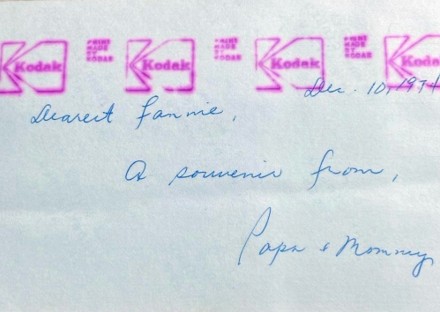
The inscription written behind the photo (December 10, 1974: “Dearest Fannie, A souvenir from Papa and Mommy”). (courtesy of the Ante family).
The entire creation of this work is open, as the stories of Fannie and Lisa are only a part of many stories that form what is now a very visible and vibrant community in Vienna, built of Filipino healthcare workers and families that came and decided to stay. If the work tries to honor this multiplicity of experience, it should remain an active, participatory practice in which stories unfold, and the weight of these memories becomes palpable.
The art installation, A Memorandum of Understanding, is primarily a soundscape composed of a collage of family archival recordings (such as cassette tapes sent to family abroad), interviews, songs and current narration by Fannie, Lisa and the Ante family. A textile piece, designed collaboratively, functions as a room divider creating an intimate space around the soundscape and visually references privacy curtains surrounding hospital beds. The textile piece is a collage of worked fabric, layered with embroidery and transfer prints. At the center of the “listening booth” stands a boom box, an 80s cassette tape player cast out of polyurethane and embedded with speakers. The work will be installed at the Mead Art Museum, Amherst College as part of the Independent Curator’s International touring exhibition Remittance, this September (2026).
Though the material composition of this piece may already be set, the addition of more stories to its current soundscape, like that of a mixed-tape, is of course always possible. The experiences of Lisa and Fannie are intended to provide the initial impetus, but it remains open to the addition of voices, stories, further interviews and archives, as we slowly try to give shape to the Filipino diasporic community in Vienna. Crucial to this endeavor though, is a beginning: the conversation between mother and daughter and their shared contributions (via photographs, drawings, and their voices) to this work.
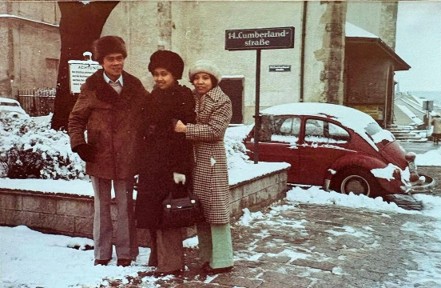
Efren (Fannie’s husband), Fannie (center) and a friend. Winter in Vienna ca. 1970s (courtesy of the Ante family).
Perhaps this is the practice (or a flailing attempt), political and utopian in its implications, of a processual and open-ended method. It highlights a decolonial way of seeing, of seeing from the margins. The work deals with the aspects of navigating and traversing different ‘landscapes’ whether cartographic and geological topographies, or internal and emotional spaces. I see them as attempts to map out different facets of ourselves—sometimes what is produced are artefacts of projection and desire (appropriated, created, disfigured, and chosen)—or representations of geographic places that also live on fictional, hybrid or even barely composed planes. A Memorandum of Understanding tries to tease out possible entanglements between a here and a there in an understanding of migrating identities: a study that although based on the historical construction of big narratives, also drifts towards the auto-ethnographic.
The book, Traité du Tout-Monde was Glissant’s first theoretical work explicitly committed to poetics in global interconnectedness cites. Dr. Christina Kullberg, a Glissant scholar, in her article “Crossroads Poetics: Glissant and Ethnography”, articulates Glissant’s views on self-reflexive ethnography, as he was himself an ethnography student of Michel Leiris, “Glissant ultimately turns ethnography into a matter of an aesthetic appreciation of the world as a common-place, of existing, of knowing and establishing relations through the senses… he developed concepts for exploring ethnography as poetics in which the real encounter is a sensuous experience that informs the imaginaries of the world…” (Kullberg 2013). As my own archipelagic imaginary draws heavily from Glissant, a description of it seems apt to end with: “[all] archipelagic thinking is a trembling thought, a non-presumptuous thought, but also a thinking which opens out, a sharing thought.” (Glissant 1997, pg.231).
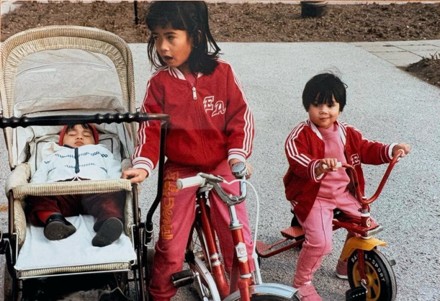
Lisa (center) and her siblings, Vienna ca. 1980s (courtesy of Lisa Ante).
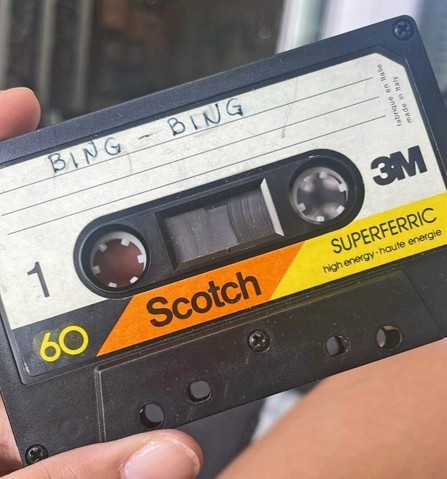
A cassette tape recording of Lisa (also known as Bing-Bing) at 3 years old, that was sup-posed to be sent to the family in the Philippines (courtesy of Lisa Ante).
References:
¹ Kullberg, “Crossroads Poetics: Glissant and Ethnography”, Callaloo, Volume 36, Number 4, Fall 2013, pp. 968-982
² Glissant, Édouard. Traité du Tout-Monde. Paris: Gallimard,