

Abstract: This essay arrives as a special contribution to IEDA from my ongoing PhD research and practice, titled Intergenerational Archival encounters (the challenge of the banal, leisurely, and everyday, South Asia WWII 1940s to now). My research introspects and enters with a personal and familial archive. AWorld War II scrapbook and photo album of a South Asian Indian Muslim soldier fighting the imperial war as a soldier in King George’s Own Central India Horse Regiment. My grandfather’s archive is filled with opera tickets, laundry bills, group photos with artillery and maps that denote the regiment’s movements across the Red Sea, the Suez Canal, and the Mediterranean; it inhabits the leisurely and everyday within the regimental. Scholars and historians such as Gajendra Singh, Ghee Bowmen, Yasmin Khan, and Raghu Kurnad work on historiographical accounts of the contributions and colossal presence of South Asian soldiers in WWII and their conditions, they assert the passive imperial whitewash of the contributions of these soldiers and that there is no WWII internal collective South Asian memory. As a Muslim, Pakistani, South Asian woman in London now, I have taken on the challenge to work with and investigate this persistent coloniality and past and present, quotidian, structural racism through intergenerational archival encounters.
The archive operates more so as a navigational tool in this unfinished history, to establish a biography of the research, Library and the Imperial War Museum. The archive is a way to account for the conditions of my existence in the present and it operates as an intertemporal and interstellar vehicle for analysing our intergenerational linkages. This enables me to navigate the intergenerational and ask: What’s the relation between the colonial violence of the 1940s and its intergenerational links to the present? I approach this by considering David Scott’s idea of generations as social institutions of time[1]. I identify that establishing these intergenerational links between the 1940s and 2020s will require care and curatorial attention to magnify and describe structural racism which inhabits knowledge production/extraction, and allocation of resources among a few of its disguises. I approach this problem with the construction of a conceptual apparatus that is sufficiently attuned to attend to the violence of the uneventful. The Scrap-ed and embodied encounters in this essay arise out of this conceptual apparatus.
Keywords: Intergenerational, Scrap-ed, Postcolonial, Quotidian,
Leisurely, Violence, Subcontinent, WWII
–
Scrap 0
A prelude from Ghazi’s diary
In his WW2 diary, Ghazi mentions Ram Del as his dear friend.
Ram Del’s words (14th November 1949)
“My father travelled back to Lahore (Pakistan now) recently to receive his amanat . There is no appropriate translation for the word amanat in the English dictionary; it is when something truly valuable to you is left behind for safe-keeping with the ones you trust. As expected, they had safeguarded it with all their hearts and might, even more than their own belongings. The point of religion was where both sides failed to negotiate, so loves or friendships like ours, Sakina and I or Ghazi and I were doomed. The British were intelligent enough to use exactly this. Between riots and rising hatred, some epics of friendship and trust endured on both sides of these newly found borders”
Scrap 0.1
A note on the intergenerational and the interview
I see David Scott’s (2014) acceptance and his own inability to understand or value the preoccupations and desires of the earlier generations and how their political visions and lives were in rhythm, as integral to the survey. There was a lack of vigilance and sensitivity about the notion of the past that informed and aided their present for the future they desired. I am inspired to work on reconstruction and writing from the inside on the intellectual and ideological problem space “the anti-capitalistic search for a socialist change” (Scott, 2014). ‘We’ reflect on inheriting these as a ruin.
Working with the structured life interview which intertwines dialogue, time and works as both exploratory and participatory, Scott and the interlocutor are not looking for sealed truths and the dialogue is “open-ended, unpredictable and open to contingency” (Scott, 2014). I work with the archives, memory, the intergenerational and the autobiographical in a similar exploratory manner – the questions and answers are conditioned by each other. The aim is to listen and find clarity, rather than searching for reasons to agree or be critical.
Scrap 0.2
A geographical and historical climate
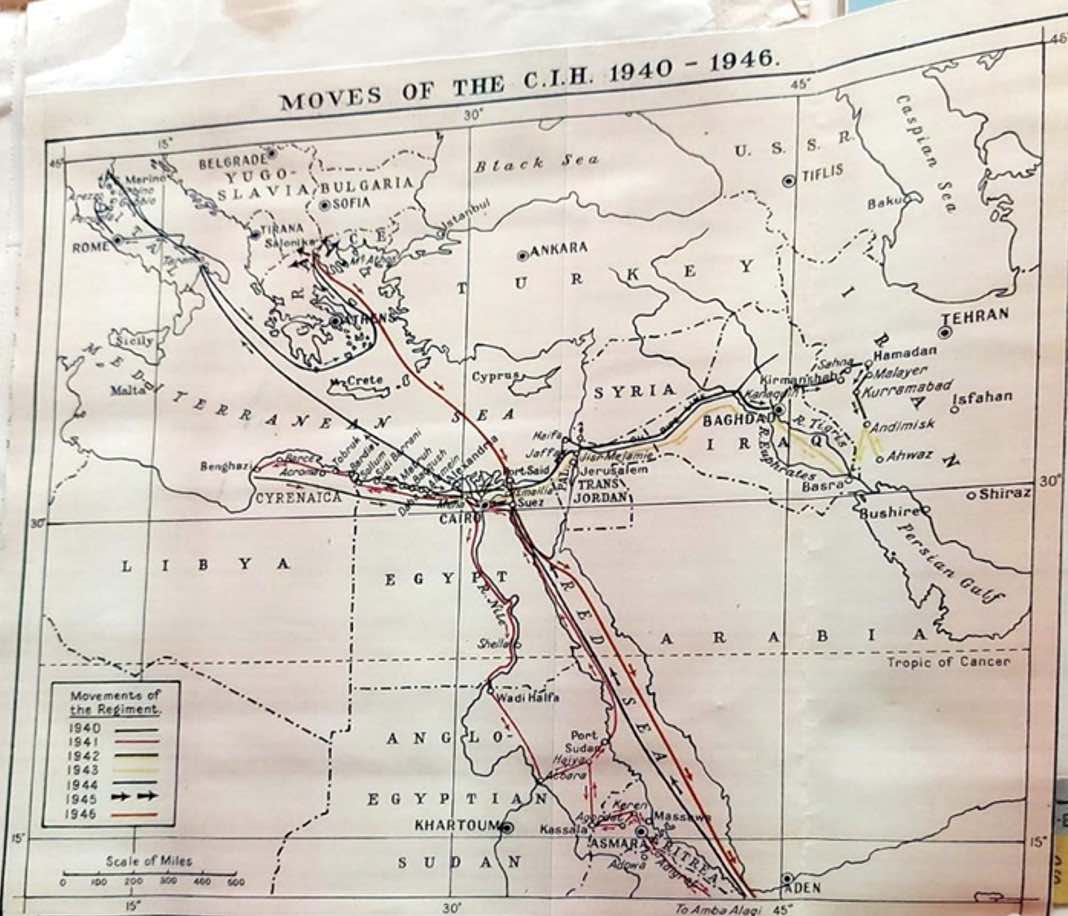
This map of the regiment was pasted by Raja Ghaziuddin Hyder (my grandfather) in his war journal. The historical and geographic reading of this regimental map may appear unnecessary but it is crucial to set up a backdrop for this scrutiny. The conflict between the Axis and Alliance powers in the Second World War and the efforts and sacrifices by the colonial Indian soldiers are revealed here in simple linear movements that carry the colossal weight of war, conflict and colonial time zones from 1939 to now. History and geography fade inherently into the current times, from political tragedy, war and conflict to its brunt in everyday lives. I read the map with support from the regiment’s war diaries that are available at the National Archives, Kew Gardens (Archives, N 1940) and a registered online WWII group (Central India Horse, 2023), with discussions from retired army officers and experts in the field. My approach is deliberately non-chronological, due to the urgency to indicate moments and times that spark reflection, discourse and problems. I weave in documents and photographs from my grandfather’s war Scrapbook journal/ album and archival encounters in institutional atmospheres such as the Imperial War museum, British library India office and the National Archives Kew Gardens. The Soldier’s Corner (a Sunday column published in the Statesman on Sunday) is one such encounter that helped to narrate and interrogate these intergenerational, autobiographical and biographical dilemmas.
CIH Movements – Reconnaissance and the
Sangro-river 1943/44
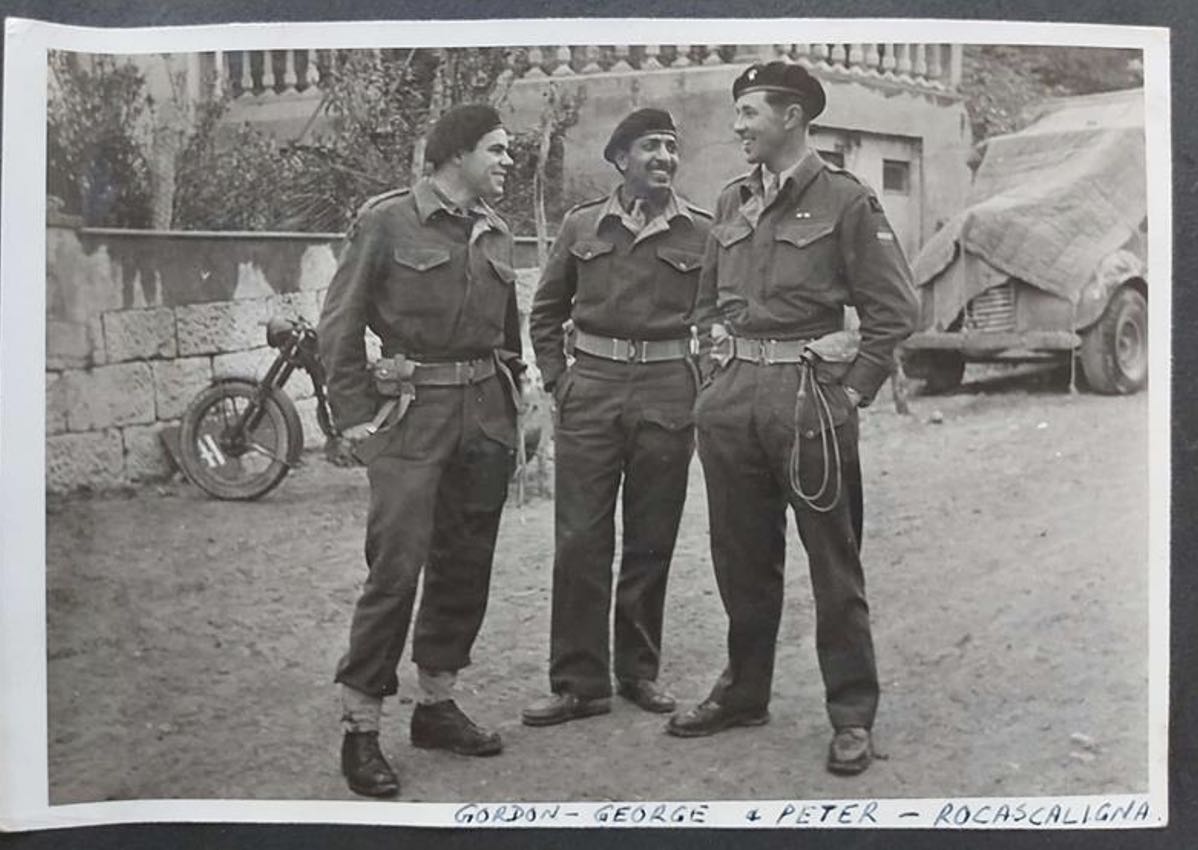
The central India horse re-joined the 4th Indian division upon arriving at the Mena Camp (Egypt) and from there it proceeded to Italy, to arrive in Taranto on the 8th of February 1944. The CIH in Taranto (Italy) was equipped with a jeep troop, a rifle troop, Humber IVs, 2 carrier troops and a rifle troop in armour-wheeled trucks. They became the V Corps reconnaissance regiment upon arrival at the Sangro River while serving under the ‘D’ Force with the 11th King’s Royal Rifle Corps during March.
On the Sangro River and the Indian Soldiers
On the 3rd of September 1943 the Italian mainland was invaded by the Allies, this triggered the re-entry of the Italians into the Allied side. The motive of this Allied entry was the exit of German troops from the fronts in Russia and especially France. The Allied troops made remarkable progress despite stiff resistance and by October the Allies had to withhold themselves at the Gustav line which is a defensive position in the German winter. This position stretched from the Garigliano River in the west to the Sangro in the east in Italy. The allied force reached the Adriatic coast in early November and got ready to attack positions at the Sangro River. By the end of November, the entire ridge overlooking the river was under the Allied forces.
A cemetery site was chosen for the graves of the men who fought this fierce Adriatic battle between November and December 1943 and the quiet period after it. The cemetery also carries the graves of prisoners of war who escaped to reach the Allied lines and lost their lives on the way. The “SANGRO RIVER WAR CEMETERY contains 2,617 Commonwealth burials of the Second World War. Within the cemetery will be found the SANGRO RIVER CREMATION MEMORIAL, one of three memorials erected in Italy to officers and men of the Indian forces whose remains were cremated under their faith — the other two cremation memorials are in Forli Indian Army War Cemetery and Rimini Gurkha War Cemetery. The memorial at Sangro River commemorates more than 500 servicemen” (CWGC 2023).
The reconnaissance soldiers were responsible for mobile excavations on enemy borders and territory. R.G Hyder and his regiment arrived in the Sangro River region just a few months after the Adriatic Battle. The Indian Army war cemetery spells a reminder and the probability of R.G Hyder’s death during reconnaissance in Italy and the earlier battles that the regiment fought and supported.
The reconnaissance soldiers were responsible for mobile excavations on enemy borders and territory. R.G Hyder and his regiment arrived in the Sangro River region just a few months after the Adriatic Battle. The Indian Army war cemetery spells a reminder and the probability of R.G Hyder’s death during reconnaissance in Italy and the earlier battles that the regiment fought and supported.
Scrap 0.3
The Unsigned Declaration – on Resistance
Stephen Slemon interrogates the idea and notion of resistance in his essay titled: “Unsettling the Empire – Resistance Theory for the Second World” (Slemon S, 2003). He argues that political writing has struggled to navigate the term resistance and the controversy it brings, especially in the context of its understanding across the political world and literary texts. Cultural institutions such as universities shape the discourse of post-colonial resistance and have autonomy on which voices should be amplified. When resistance becomes solely dependent on literary writing from the third and fourth world, there can be an indifference to the possibility of anti-colonial literary acts in other cultural locations. Resistance, in its general understanding and first conceptuality, is seen as a position that hopes for the liberation of the oppressed and is deeply immersed in their lives. In this way, literary resistance arrives as a sustained and organised methodology for national freedom.
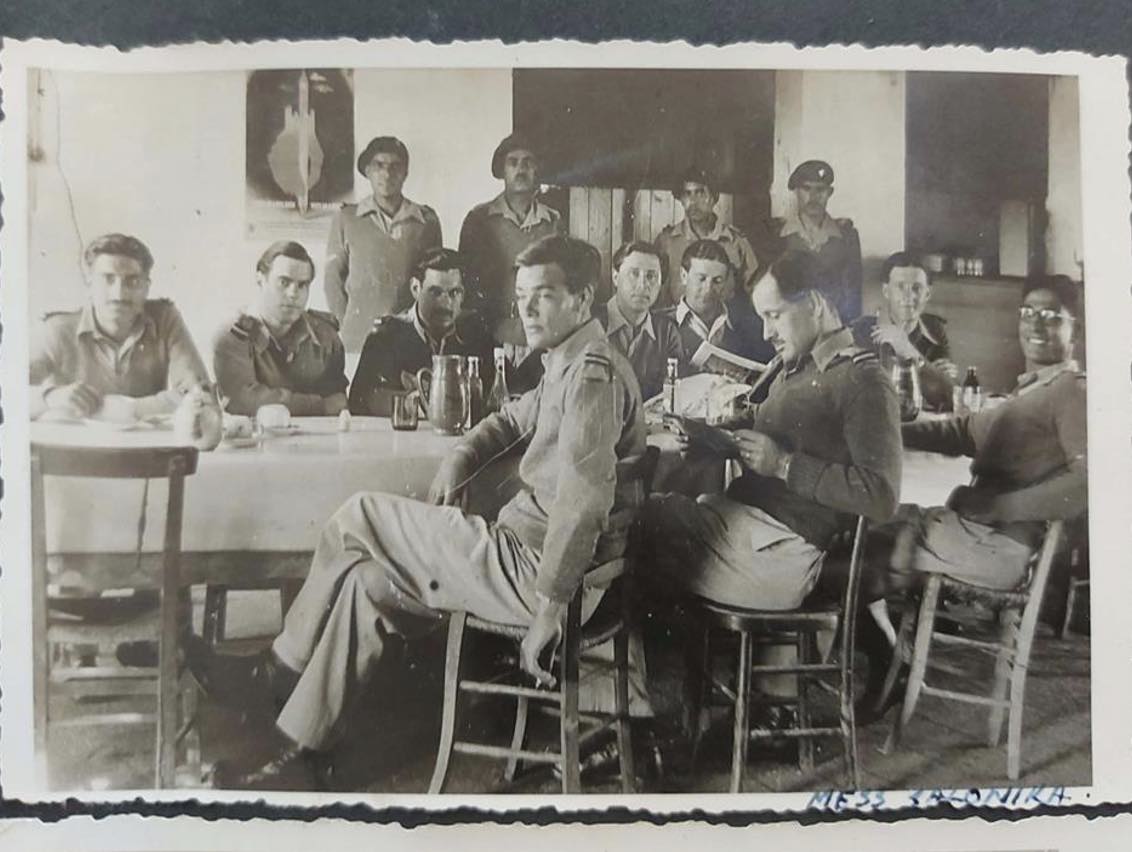
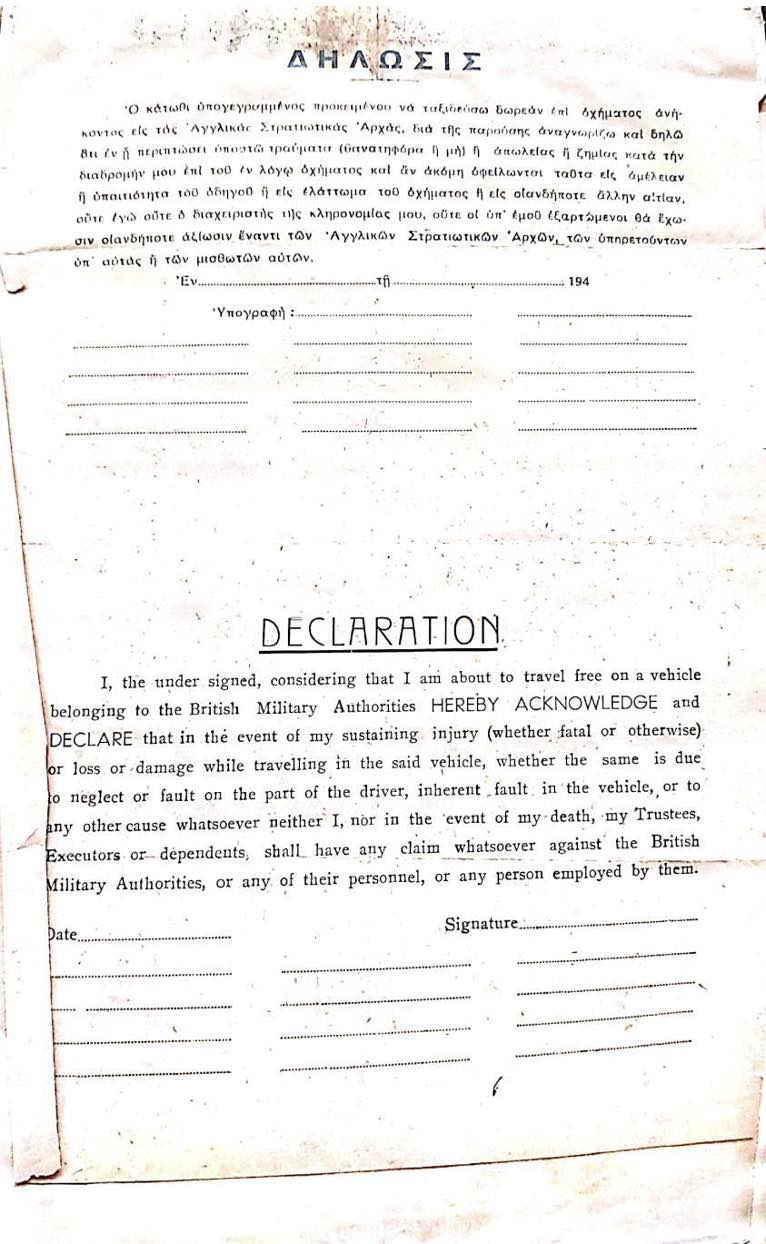
This declaration document (Figure 3) arrived between 1944–46 when my grandfather was in Greece in Salonika. This supposition is convincing because the document copy is divided into and written in two languages, the script on the top being classical Greek and the text on the bottom being English. There are many times in our lives when we are handed contracts/documents, but we are hesitant to sign them even when we are already obligated to the system or institution that has published them. This document gives a detailed account of transportation methods/vehicles that my grandfather, a serving artillery soldier in the British military, would use — it informs of all chances and possibilities of accidental death. It conveys that the undersigned has declared that this won’t be the responsibility of the British Military Authorities in any situation. It reads; “DECLARATION — I, the undersigned, considering that I am about to travel free on a vehicle belonging to the British Military Authorities HEREBY acknowledge and declare that in the event of my sustaining injury (whether fatal or otherwise) or loss or damage while travelling in the said vehicle, whether the same is due to neglect or fault on the part of the driver, inherent fault in the vehicle, or to any other cause whatsoever neither I, nor in the event of my death, my trustees, executors or dependents, shall have any claim whatsoever against the British Military Authorities, or any of their personnel, or any person employed by them.”
As I discuss the breadth and depth of my grandfather’s soldierly movements through this imperial war and the CIH map, the document reinforces that the British Military Authorities, i.e. the imperial government that my grandfather was serving as a soldier from colonised India, are not to be held accountable by Raja Ghaiziudin Hyder or his ‘trustees, executors or dependents’ in the case of an injury or his death. While the journal and his war album create the narrative landscape of his time and commitment through those years and he pens down banal responses to flight times, food and durations inside travel feedback cards, even much after this document was received — this document remains unsigned.
This unsigned document also reminds me of the official hospital consent documents when a loved one (family) is about to enter into a surgical procedure and one family member has to sign a consensual document that declares that in case of the patient’s death, the hospital won’t be held responsible. It reminds me of how my father fled the hospital when called to fill out and sign that consent form and my mother had to sign that document when I went through major surgery for an arm fracture as a twelve-year-old, I remember the look on my mother’s face, the look of helplessness and courage, hope and despair. It also reminds me of signing the consent forms when my father went through debridement and amputation surgeries due to the terror that is ‘gangrene’. I remember signing these documents in numbness, as an obligation but not actual consent — how could I give an institution the authority to take my father’s life with one signature? In the case of hospitals, the procedure discontinues without those signatures, so I was a prisoner to that agreement. It must have been expected from R.G Hyder to return the signed document to the British Military Authorities but it remains unsigned and glued on his journal to date.
Pure resistance is contested by theories of subjectivity which stress that it is a culmination of conflicting ideological structures and subject formation. That being said, resistances are also determined by power itself and it strives to withhold them. Resistance is a landscape of contradictions and it dwells ‘guilty’, inside and between the systems. This realisation can proclaim that third-world resistance writing is dual in its existence between both worlds yet contextually situated within first-world politics. This contests centered and influential first-world postcolonial critical theory. By choosing to keep this document unsigned my grandfather refuses to abide by the coloniser’s narrative and authority. This act silently contests the colonial endeavour to release themselves of charges that reveal the tyrannical nature of the imperial war that he served in. This not-signing may serve as a form of resistance that interjects the power narrative to establish an agency within the colonial setting.
Homi Bhabha’s ideas in his essay “Signs Taken for Wonders” (2003) resonate with the urgency of my grandfather’s archive. I argue that this unsigned document in his journal is a sign, an act and a form of resistance itself. Bhabha explains the realm of transparency as a signifier of an expansive resolution and the modern authoritative voice – yet this authority and its rules arrive with the baggage of socio-cultural texts and nationalist ideology which are resistant in the colonial context. This resistance is precarious and not just rooted in political disagreement — its precarity is generated within the focal discourse of colonial power which aligns the symbols of cultural difference with colonial hierarchy.
This ambivalence stands out in the case of my grandfather’s British Military Authority unsigned document. He chooses to deny responsibility for his death while serving in the colonial war. This act and document can be seen as an intervention in colonial power and its fluctuating presence. This document’s presence in Ghaziuddin Hyder’s war journal arrives as a form of resistance. It silently instigates disability in the colonialist rule and challenges their control. It reveals the conflicted spirit of colonialist power and its urgency or tactics to assert authority through practices of discrimination or escape from accountability.
Authority relies on the unanimous validation of its knowledge centers and sources, which must be in full visibility. This requirement for proof creates an uncertainty of those in power. Bhabha argues the evidence and signs which signify authority can be recognised as hollow tactics and strategies — but they can still perform whatever is expected of them.
Scrap 0.4
An Interlude
Ghazi’s Amanat
Ghazi’s Diary (23rd February 1946)
I wake up, Salonika’s light doesn’t hold any trace of this war that I have come here to fight, it peeks through the curtain. I had been dreaming of the Dal lake in Kashmir where I went with J for our honeymoon last year over the one-week leave to get married and be with her, I write to her every day, I dreamt that the Shikara (houseboat) from Kashmir had sailed to the Mediterranean and somehow war felt like peace for a blink — there is no drill today, our officer told us that this weekend will be off for the regiment — it’s a Sunday — I reach out to grab the Statesman on Sunday that should have been kept next to my bed by my friend Ram Del who knows that the first thing I like to do on Sunday mornings is to read the Soldier’s Corner by Bhai, especially here in Greece for a few of us who savour it. This is published in Calcutta and Bhai writes it for my British colleagues who are in my homeland, India, right now. My friend Stott has asked me several times why I read this column if it’s meant to be for the British soldiers and being Indian, he presumes that I already know India well enough… I smile… there are two things or more, no one can ever know India well enough, secondly, Bhai (Urdu/Hindi word for brother) is a brother writing for his brothers and how can I not join in, and thirdly, when Bhai thinks and shares about Monsoon and Eid, mosques and temples, Paan, art and poetry, I feel closer to home…
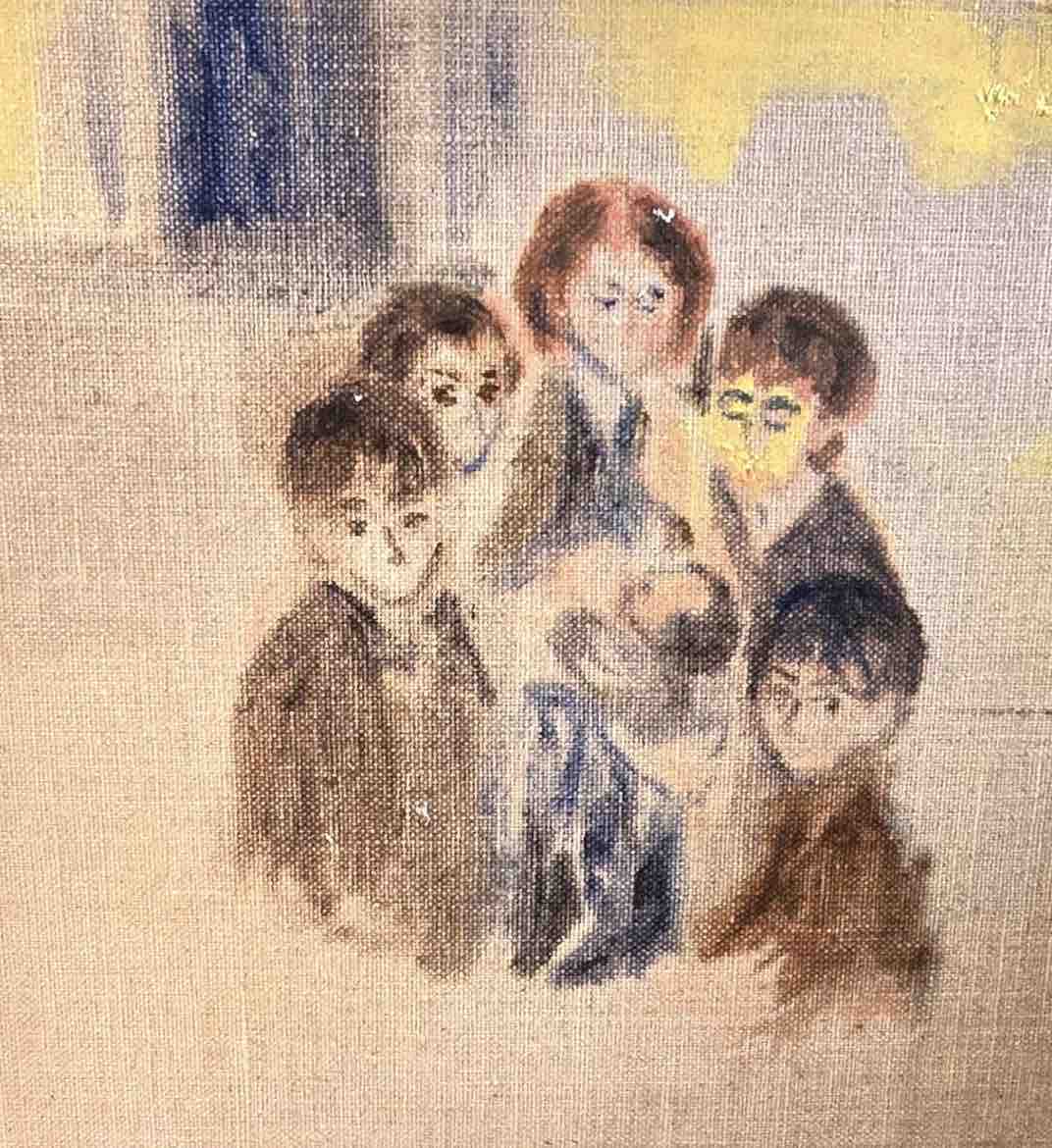
I had woken up early, so I walked to the Kappani market for a fresh espresso. Ram Del followed me and said I had received a package from London. This parcel package that I received today has been sent from Lahore. I open it, my hands touch it and it has a softness that reminds me of being in love, of the specs of gold that envelope the atmosphere in the fertile season of wheatfields in my village in Punjab or the mane of a newborn horse that I dreamt of running my fingers through or maybe, when a slice of the sun would mellow down and choose… to sit… inside your eyeballs — it is unexplainable, I held on to this cashmere yellow scarf with no sense of time, unfolded it and wrapped it around my neck.
Sehr (28th December 2023)
The air smelled of a Lahori December sunlight and the scent of cardamom and garam (hot) chai — the piles of wool, leather, patterns and colours on this infinite horizontal army of withered wooden carts that lived behind an invisible curtain of this chai haze, almost felt like a blurred filter. Whenever I go to the Landa bazaar to excavate unknown treasures for my wardrobe or life, I feel no different than the clusters and commotion of all the leftover material in this bazaar. How am I any different than the piles of Prada, Gucci, Adidas jumpers, or Italian leather jackets that were made in Pakistan, India or Bangladesh, travelled globally for export, rejected on some quality assurance checklist and travelled back through sea and air in Lahore’s Landa Bazar, largest western brand dump wholesale export market?, stitch, form, shape, colour, pattern, trend, be it colonial, textual, state, national, colour, race, maybe I carry and have been engendered as a leftover by leftovers — “Oh! Enough of your madness Sehr, what an obscene parallel” I thought to myself— walking in-between and past the narrow passage between street food vendors on their cycle carts on one side and the chai haze with piles of clothes on the other, my favourite old, weaved, crochet basket bag got disrupted and stuck into the corner of a cart. As I hurriedly and intently separated and untangled my bag from this wooden corner with metal rims, the softness of yellow cashmere beamed into my heart from the corner of my eye, my hand immediately leapt into the pile to whisk it out, it melted into my skin, there was something about this piece, a scarf, yellow, so fresh in all the yellow and age it carried that I had no choice to part with it “how much for this ?” “You have an eye, this is vintage miss.” That is always a marketing technique I thought but this time it was different, the scarf had an eye for me, it had chosen me, “where do you think this is from, the tag is faded and almost torn off…” I said while looking closely at its edges on all four sides. “We don’t know, but it will never age, as you can see. It grows more beautiful with time.” I imagined someone wearing it while having an espresso in some part of the world, years ago, how did it get here I thought? From Victorian lace curtains to vintage cameras and typewriters, I had found and encountered hidden gems here for years through my excavations. This was different, it was not curated chaos or exoticised or over-priced vintage like some wholesale vintage or import and export dump markets I’ve been to in London and around the world — it happened on its own — shop upon shop, cart upon cart, and pile upon pile and we became one with the objects, they found me while I looked around in oblivion.
Ghazi (5th June 1946)
This scarf was sent by J, her cousin got it as a gift for her from Italy and she writes that she felt that it was meant for me. I wore it every day, sometimes I imagined it around my neck over the regimental Central India Horse uniform. It had become a part of my body and being, everyday ‘wear’ didn’t wear it out, I couldn’t understand, there was something in it…maybe its yellow spirit, which didn’t let it wear out or age…
Scrap 0.5
Corners? Between Bhai, Soldiers, and Me
British Library and how I got to it (entering the institutions).
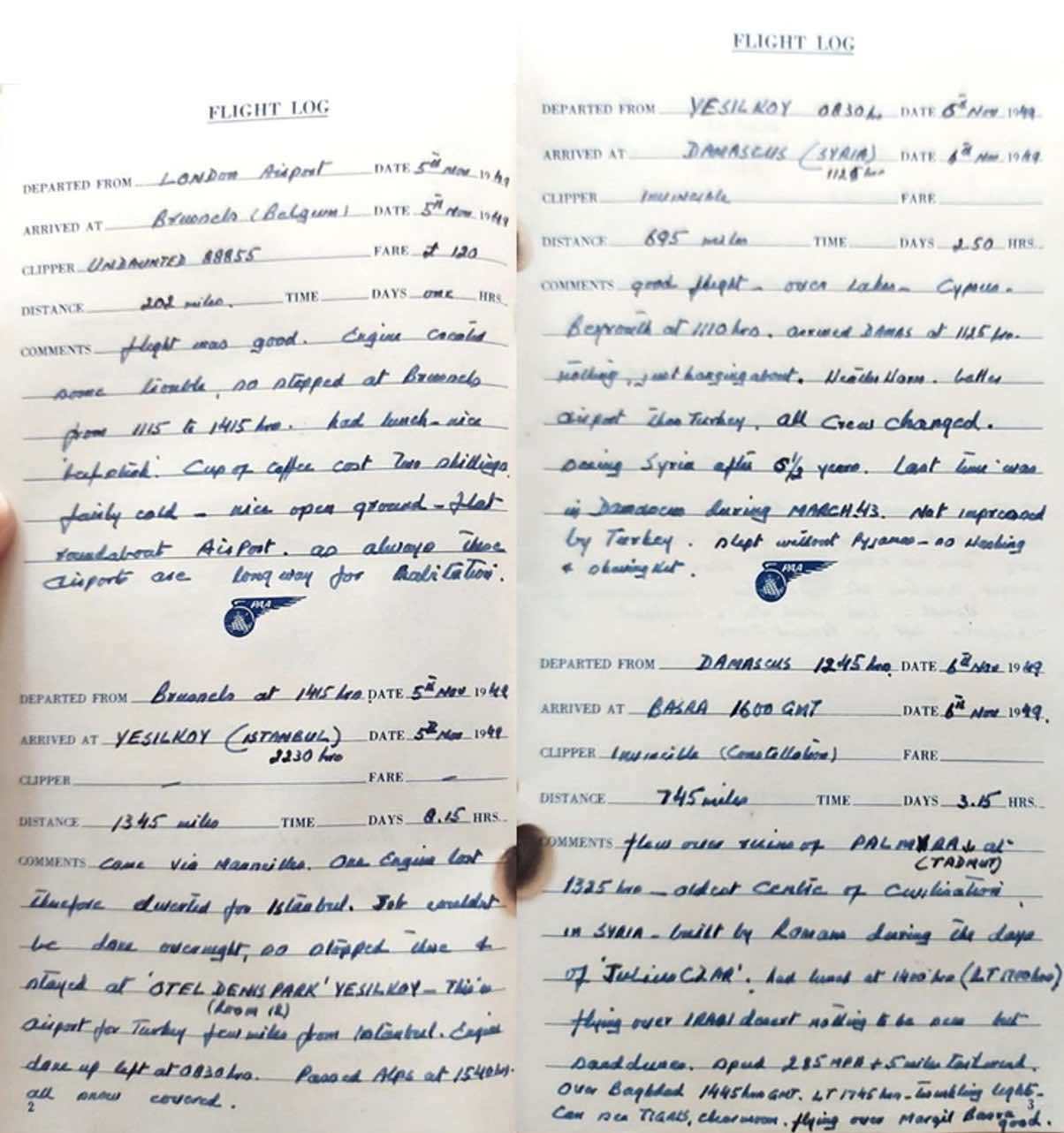
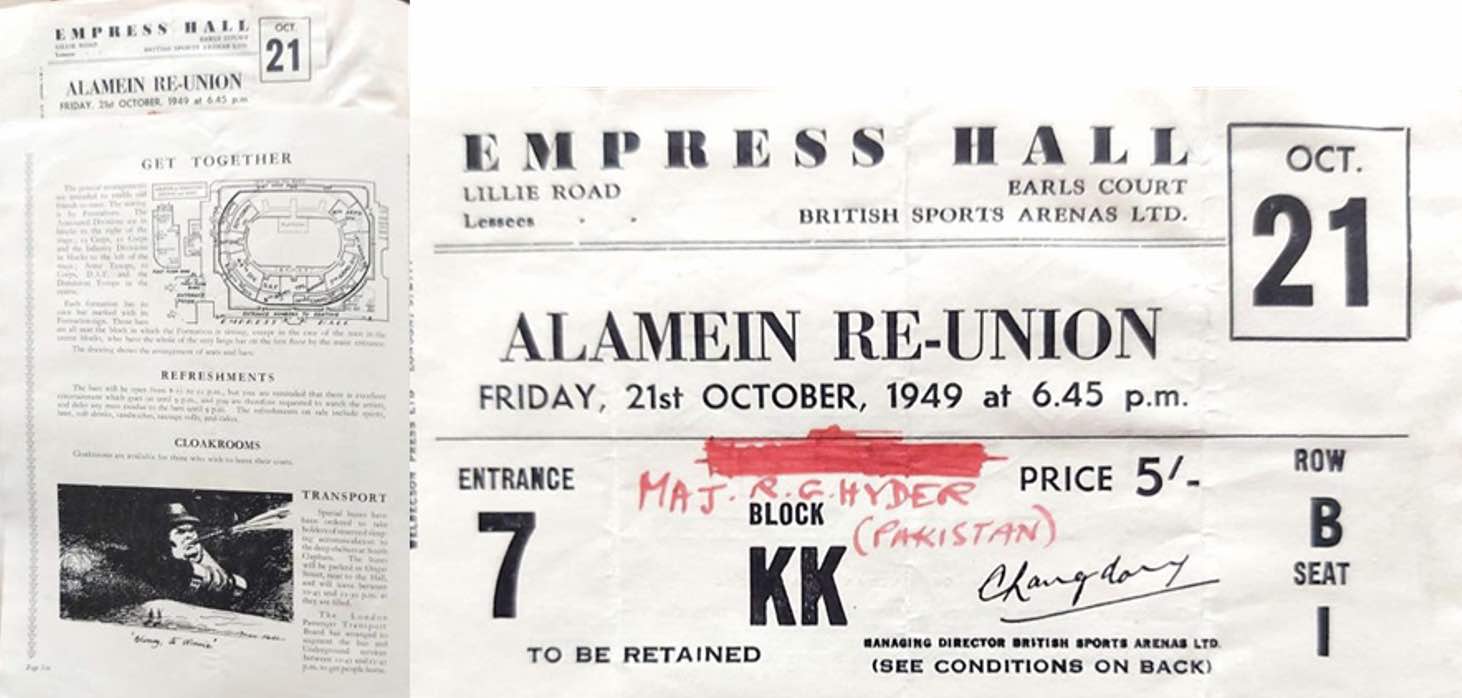
I arrived in London in September 2021 with copies and digital files, scans and ‘photographs of photographs’, of a World War II Muslim Indian Soldier’s (nana Abu, my maternal grandfather) banal and everyday scrapbooking and photo album of his time and movements serving as an Indian colonial soldier. I wasn’t prepared for the magnetic or inherent power and pull of the institutions on my arrival but the images and ‘memory’ I brought along were inevitably pulled toward structures of power and knowledge gatekeeping and production such as the Imperial War Museum and the British Library. I entered or I desire to say ‘the archive entered these spaces’ with a sense of surge to join some dots in the ‘out-of-jointness of time’ (Scott, D. 2014). The journal and album had sufficed and survived intergenerational and geographical movements, upheavals, familial tragedies, losses, hopes and joys from the 1940s to the present, it was introduced to me by my uncle in 2016 due to my deep interest or curiosity in familial memory, paraphernalia or documentation. Most of my generation isn’t interested and my uncle never expected interest, he only shared if he identified it or was requested. Also, it is important to share that safekeeping of familial histories, albums and paraphernalia is an anomaly in South Asian households, as mentioned repetitively by Ghee Bowmen in his book The Indian Contingent (2020) or Raghu Kurnad in the fictional autobiography, The Furthest Field (2015), WWII does not exist at all as a collective memory in South Asia — post-colonial, national textbook histories have never included the 2.5 million soldiers who served in the British Indian Army and any familial documentary proof of them on a larger scale has been compromised to damp or forgotten storage spaces, silverfish or movement, as the new generations remained unaware of them. My uncle has shared his dismay with me over many occasions; other relatives, and forefathers who served in WWII have no accounts, recollection or memory of their services left with their younger generations, so the recollections I encountered were singularly the result of ‘one’ individual’s effort due to his devotion to knowledge, history, memory and love and appreciation for his father.
Who is Bhai?
In the first column on Sunday, June 14th 1942, Bhai introduces the Soldier’s column stating that India is a place that is meant to charm and perplex its visitors. He shares that the white British soldiers have a temporary home in India and that in their expeditions between witnessing different sights and villages, they need to understand and live within the climate and language. He also shares that an exchange of each other’s stories will update the people in India with the pastimes of the youth in Britain and vice versa. Bhai claims that his weekly feature will also nurture new bonds of friendship between Indian sailor soldiers, airmen of the empire, and allies now in the country. He further explains that the purpose of this column is for the soldiers to understand India inwardly beyond the stereotypical perceptions of being an ancient civilization, Kipling’s Kim (in the novel), or a region of problems/discrepancies. He shares that India is beyond this, in span it is a country almost as big as Europe, with agricultural and rural life at the forefront.
He explains that within this history and climate India is currently in a favourable position of a balanced economy, as opposed to the ‘Western modern world’ who are sufferers “of a surfeit of a modern civilization” (Bhai, 1942)). India’s soil and culture are grand in their offerings, its visitors will find a haven from speed, mass production and its complexities — they can watch the countryside and Indian panorama to contemplate and relax. For Bhai, the column will also be a window to generate common interests such as new games and sports. He states that friendliness is one of the main characteristics of Indian people and that the weather changes their temperament and governs life in India for instance short tempers are a result of the scorching sun while rain in the countryside awakens new spirits, brings people together and forms new friendships, the rainy monsoon season is all about good vibes. He shares a grapevine from a village where the soldiers were witnessed giving swimming lessons to the village children, while the children shared a trick or two as well. Both sides couldn’t communicate with language, but direct communication, respect, trust and mutual regard made it happen. References and scraps of the everyday and the leisurely such as theatre tickets, laundry bills and brochures in my grandfather’s scrapbook and album intuitively led me to Bhai’s column and the discussions within it. Such paraphernalia may seem out of place within a war context, but it offers a more profound understanding of the co-existence of leisure and war, where there were moments of joy and relaxation found amidst the hardships of war. This survey of my grandfather’s experiences reveal how joy and comfort helped one cope with the stress, longing and trauma that came with the war. This deeply resonates with Bhai’s project, where a leisurely Sunday column that familiarises the white British soldiers to India and its way of life, uncovers stories of race, class, challenges and colonial violences.
Scraping off an autobiography of colonial times zones – between me, my grandfather and the soldier’s corner.
The soldier’s corner, my grandfather in the war and me in London (2021 till present), form this imaginative corner space between trans-generational, colonial, and post-colonial pulls and spaces. I arrive and settle in this cornered space of ‘colonial time zones’ to scrutinise and reflect on the insurgence, tension, post-colonial dilemmas and the everydayness that creates and informs my identity and my existence in the now.
I am in the space between my grandfather’s World War II journal/archive and my own post- colonial existence as a South Asian Pakistani Muslim woman in London. The autobiographical genre has a core role in this undertaking as it permits me to approach the Indian Subcontinent and its ideology within the framework of religious groups, caste, and kinship networks i.e. a landscape where powerful cultural and social domains aid agency and personal identity. On the contrary, engagement with my grandfather’s life history helps me to instigate a dialogue between society and the self. I explore how his life and experiences as a soldier from a colony interject with underlying societal and historical narratives.
Anshu Malhotra, and Siobhan Lambert-Hurley (2015) stress how important it is to acknowledge that the idea of a free and unified identity or self has been repeatedly identified as a myth, especially in black, feminist, American critiques and postmodern thought. Selves are a culmination of cultural norms and power technologies that are forced by the state — and this makes them relational in their understanding. Therefore, I engage with my grandfather’s archive not only for personal identity but also to understand how his experiences were shaped by overarching contexts of history and culture – and how they continue to shape my own.
Scrap 0.6
Folding and unfolding
London 2021–23…25…
Colonel and Begum Hyder
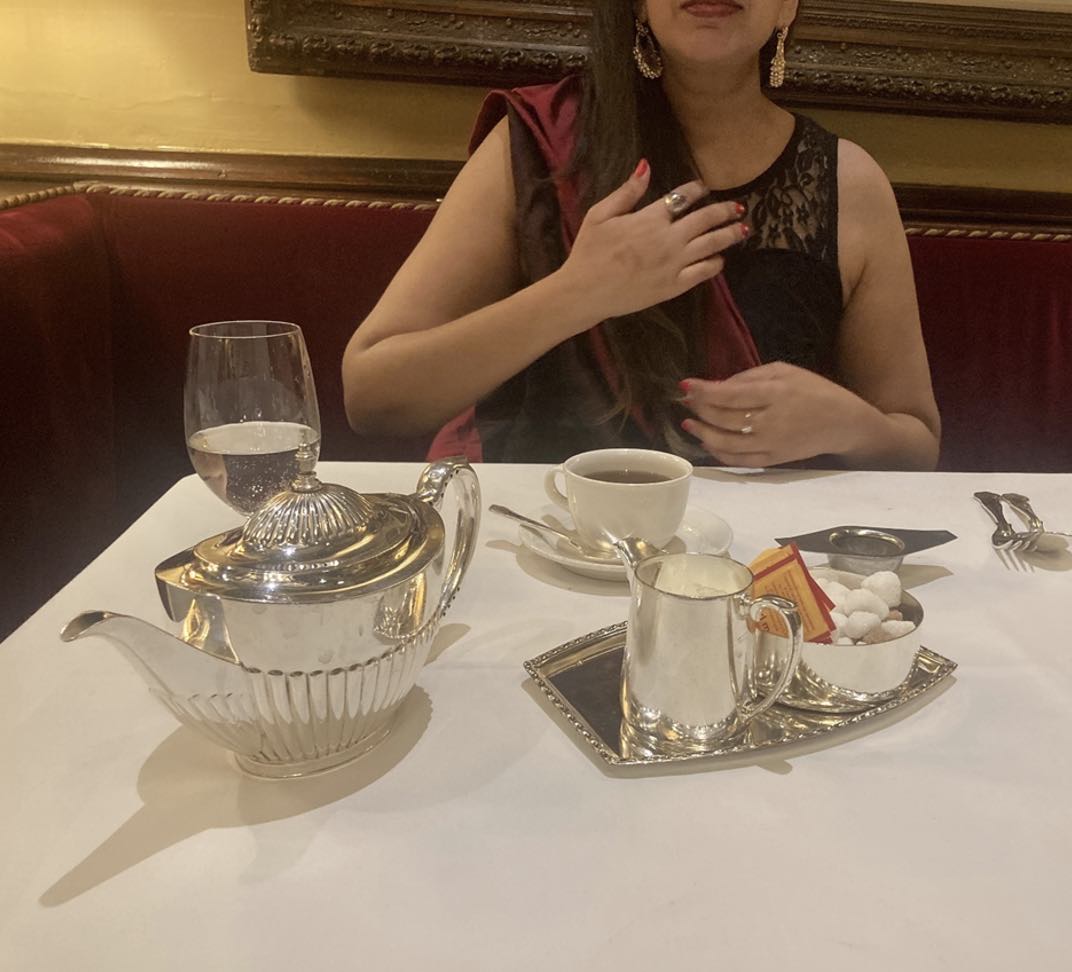
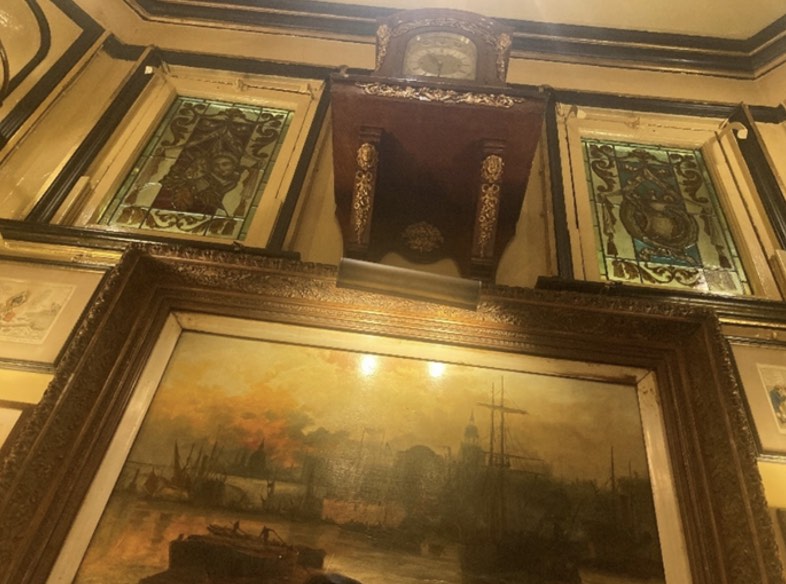
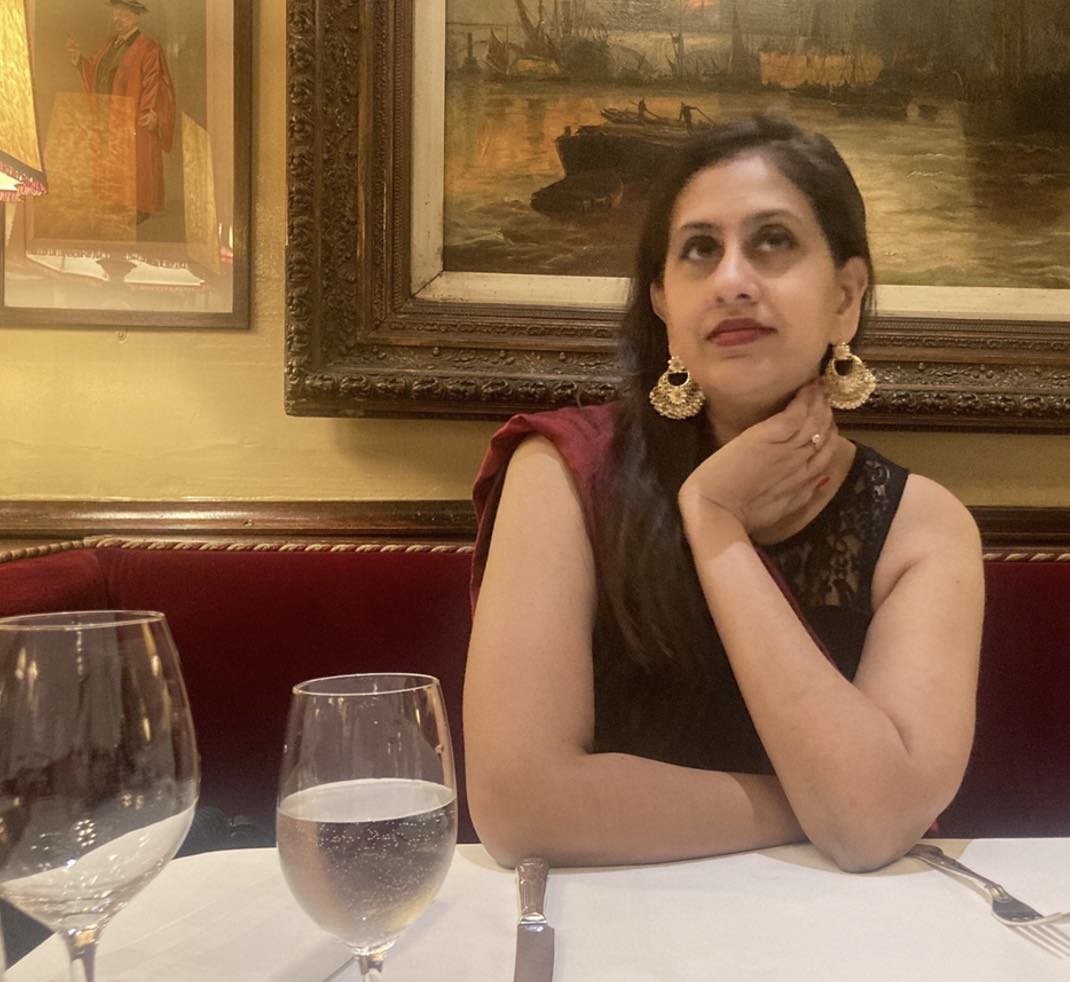
“I fold this banarsee deep maroon pure silk saree back into my bag, I wrapped it loosely onto a dainty black net dress that I bought online from a second-hand clothing app… I arrived here in this restaurant to perform and document an artwork that I had envisioned, but now… I didn’t enter wearing this sari, elegant and tall with heels, but it was kept folded inside my bag as it had to be a secret. The reason is the same old: permissions… permissions to enter, permissions to do, permissions to be… I went to the restroom and let the sari fall and dance loose over me and the black dress. The act felt regal yet meagre, the folding and unfolding before and after is a camouflage…”
(A narration excerpt from the Video Performance Colonel and Begum Hyder)
Sehr Jalil
Goldsmiths, University of London & National College of Arts, Lahore
Sehr Jalil is a multidisciplinary visual artist and researcher. She works with ideas and issues of memory, archive, intergenerational relationships, race, class, and post-colonial identity politics. She’s a doctoral candidate at Goldsmiths, Department of Visual Cultures, University of London, and a Lecturer in the Department of Cultural Studies at the National College of Arts, Lahore. She is currently based in London and on leave for her PhD.
References
Anshu Malhotra, & Lambert-Hurley, S. (2015). Speaking of the self: gender, performance, and autobiography in South Asia (p. 8). Duke University Press.
Slemon, S. (2003). Unsettling the Empire – Resistance Theory for the Second World. In The Post-Colonial Studies Reader (ch. 16, pg 104 – 110), Routledge.Taylor & Francis e-Library.
Bhabha, H. (2003). Signs taken for wonders. In The Post- Colonial Studies Reader (ch. 4, pg 29 – 35). Routledge.Taylor & Francis e-Library.
Bhai, ‘Statesman on Sunday, Soldiers Corner’ (14 June 1942), British Library Manuscripts – Newsroom Microfilm reel.
Bowman, G. (2020). The Indian contingent: the forgotten Muslim soldiers of the battle of Dunkirk. Macmillan.
‘Central India Horse’, WW2Talk, accessed 12 June 2023, http://ww2talk.com/index.php?threads/central- india-horse.48930/.
CWGC, ‘Sangro River War Cemetery | Cemetery Details’, CWGC, accessed 5 January 2023, https://www.cwgc.org/visit-us/find-cemeteries-memorials/cemetery-details/2021204/sangro-river-war- cemetery/.
National Archives, ‘War Diary’ (December 1940), Central India Horse (21 King George V’s Own Horse), RC6603189.
Raghu Karnad. (2015). Farthest Field: An Indian Story of the Second World War. W.W. Norton & Company.
Scott, D. (2014). Omens of adversity: tragedy, time, memory, justice (pp. 7, prologue). Duke University Press, Cop.
Scott, D. (2014). The Temporality of Generations: Dialogue, Tradition, Criticism. New Literary History, 45(2), 157–181. https://doi.org/10.1353/nlh.2014.0017